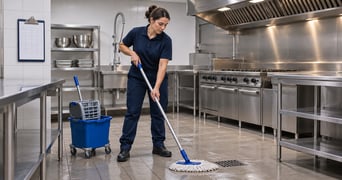
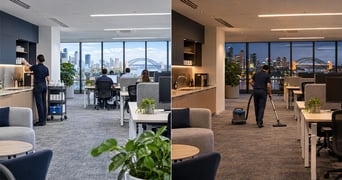
After-hours office cleaning suits most offices because cleaners can vacuum, mop and clean toilets and kitchens without working around staff. Daytime cleaning suits offices that are busy all day, need amenities kept up during working hours, or want to avoid the key-holding and security issues of night work. Many hybrid offices now use a split: a short daytime visit for toilets, kitchens and touchpoints, with floors and the full clean done after hours. Choose based on how your office is used and what your building allows, not on which option sounds cheaper.
After-hours, daytime and split schedules compared
| After-hours | Daytime | Split schedule |
|---|
| Disruption to staff | Minimal | Noise and movement; vacuuming needs planning | Low, because noisy work is done after hours |
| Toilets and kitchens during the day | Cleaned once, then used all day | Kept up through the day | Checked and restocked at peak times |
| Security and access | Keys, swipe cards, alarm codes and lock-up | Cleaners work while staff are present | Both, with fewer after-hours visits |
| Raising issues | Notes, email or the account contact | Face to face on the day | Face to face for daytime tasks |
| Labour cost | Shifts starting before 6am or ending after 6pm attract award shift penalties | Usually ordinary hours | Depends on the hours chosen |
When after-hours office cleaning is the better choice
- The office is open plan and daytime vacuuming would disrupt calls and meetings.
- Most of the work is floors, desks and bins rather than amenities.
- Staff leave at a predictable time and the building allows evening access.
- You handle sensitive work and want cleaners finished before anyone arrives.
The risk with after-hours cleaning is that problems surface the next morning, when nobody from the cleaning team is on site. A simple issues log, checked by the contractor's supervisor each week, closes that gap.
When daytime cleaning works better
- High visitor numbers, such as a reception-heavy practice, mean toilets need attention during the day.
- The building restricts after-hours access, or after-hours security costs are high.
- You want to see the cleaner and raise issues in person.
- The office runs extended hours, so there's no quiet window at night.
Daytime cleaning works best with quiet equipment, clear rules about which areas can be cleaned when, and a short list of tasks that can be done around people.
What your building will require
Most guides skip this, but in multi-tenant buildings it often decides the schedule. Check with your building manager before you sign:
- Access hours: when contractors can enter, and whether after-hours entry needs a security sign-in or swipe card issued by building management.
- Induction: whether every cleaner must complete the building's contractor induction, and how relief cleaners are inducted.
- Lifts and loading dock: whether cleaners must use the goods lift or loading dock, and whether bookings are needed.
- Waste: where bins go, which bin room the tenancy uses and on which nights.
- Alarms and lock-up: who sets the tenancy alarm, and what happens if a cleaner finds a door open or an alarm already triggered.
Put the answers in the cleaning scope so the contractor's roster fits the building from the first night.
The split schedule for hybrid offices
Many offices are busy two or three days a week and quiet on the rest. Paying for the same full clean every night can mean cleaning empty floors on quiet days while toilets run out of paper on busy ones. A split schedule matches cleaning to actual use.
Example: a 40-desk hybrid office (illustrative)
| Day | Daytime (short visit) | After hours |
|---|
| Tuesday to Thursday (busy) | Midday check of toilets and kitchen: restock, wipe benches, empty bins | Full clean: floors, desks, amenities, kitchen |
| Monday and Friday (quiet) | None | Amenities, kitchen and bins; floors in used areas only |
Review the frequencies every few months as attendance changes. If badge or booking data shows which floors are used, share it with your contractor so cleaning follows real occupancy rather than the floor plan.
Questions to settle before you choose
- What does the building allow for access, lifts and waste?
- When do complaints happen? If staff complain about toilets at 2pm, a single nightly clean won't fix it.
- How many days is the office busy, and does attendance vary by week?
- Who manages keys, alarms and lock-up on your side and theirs?
- How will you check the work? Our cleaning audit checklist gives you a scoring template.
What it means for cost
Cleaning is mostly labour, so the hours on site and when they fall drive the price. Under the Cleaning Services Award, weekday shifts that start before 6am or finish after 6pm attract shift penalty rates, and weekend work attracts Saturday and Sunday rates (Fair Work Ombudsman). A properly costed quote has to cover these. Our cleaning award pay guide explains how award rates flow into a quote. A split schedule can cost less than a full nightly clean if it removes visits on quiet days, but that depends on the site.
What to send for an accurate quote
- Office size, number of desks and number of toilets and kitchens.
- Which days the office is busy and which are quiet.
- Building access hours, induction rules and lift or loading dock requirements.
- The times staff complain most, and about what.
Get a cleaning schedule built around your office
B&K Services cleans offices across Sydney, Wollongong and Nowra on schedules agreed with you and, where needed, your building manager. Our teams are site-inducted and supported by scheduled quality checks. See office cleaning in Sydney, Wollongong or Nowra, or request a quote.
Summary
Pest control is crucial for businesses to prevent health risks, property damage, and reputation loss. Australia has many pests like termites, ants, and cockroaches, making regular pest management essential. Commercial properties should have pest control every three months, while food businesses may need monthly treatments. The frequency depends on factors like business type, location, and past infestations. DIY pest control is cheaper but less effective, time-consuming, and risky, whereas professional services ensure safe and long-lasting results. With over 30 years of experience, B&K Services provides expert pest control solutions to keep your property pest-free. Contact them today!
 1300 136 954
 info@bnkservices.com.au