1300 136 954
 info@bnkservices.com.au

Read Time: 8 Min

There is no single price for office cleaning. Most of the cost is labour, so your price depends on how many hours your scope takes, when the work happens and what the quote includes. Two quotes for the “same” office can differ a lot simply because they assume different tasks or hours.

This guide explains what office cleaning covers, what drives the price, and how to compare quotes so you are judging like with like. For how pricing works across other types of site, see our guide to commercial cleaning costs in Australia.
What is office cleaning?

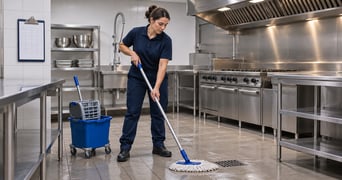
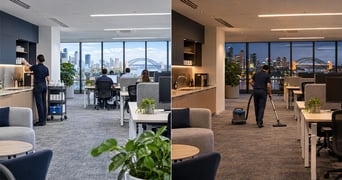
Office cleaning is the regular, scheduled cleaning of workplaces such as offices, reception areas, meeting rooms, kitchens and amenities. It is usually delivered by a commercial cleaning contractor under an agreed scope of work, often outside business hours.
A typical office cleaning scope is split into three layers:
- Routine tasks done on every visit: emptying bins, cleaning and restocking toilets, wiping kitchen benches and sinks, cleaning high-touch points such as door handles and lift buttons, vacuuming walkways and mopping hard floors.
- Periodic tasks done weekly, monthly or quarterly: detailed dusting, internal glass and partitions, skirting boards, appliance cleaning and spot-cleaning carpets.
- Specialist or one-off work: carpet extraction, hard-floor stripping and sealing, external or high-rise windows, and move-in or move-out cleans.
The clearer each layer is in writing, the easier it is to price and to check.
What does office cleaning cost? The main cost drivers
Most office cleaning quotes are built from the labour hours needed to complete the scope, plus consumables, equipment, supervision and overheads. These are the factors that move those hours, and therefore the price.
1. Scope of work
The task list is the biggest driver. Daily toilet cleaning and kitchen cleaning take far more time than vacuuming an open-plan floor. Every extra task or higher standard, such as sanitising every desk on every visit, adds time.
2. Size, layout and fit-out
Floor area matters, but layout matters too. An open-plan floor is generally quicker to clean than the same area split into many small offices, glass meeting rooms and breakout spaces. The number of toilets and kitchens, the amount of glass, and the mix of carpet and hard floor all change the hours required. Glass sliding doors on meeting rooms are a small periodic item in the same way, since grit in the track makes them drag and stick; our guide covers cleaning sliding door tracks step by step.
3. Frequency
A five-nights-a-week service costs more per month than a weekly service, but each visit is usually shorter because the site never gets far behind. Infrequent cleans often need more time per visit to catch up. Ask providers to show how the monthly price changes at different frequencies.
4. Timing and award wages
Most contract cleaners in Australia are covered by the Cleaning Services Award 2020 (MA000022). The award sets minimum pay rates and includes shift penalties for weekday shifts that start before 6.00 am or finish after 6.00 pm, and penalty rates for Saturdays, Sundays and public holidays. It also sets minimum shift lengths for part-time and casual employees.
This means when you want cleaning done affects the price. After-hours, weekend and public holiday cleaning costs more in labour than daytime weekday cleaning. Award rates are reviewed each year, so labour costs can change from 1 July. Our cleaning award pay guide sets out the current rates and what they mean for a quote.
A quote that seems far below others may not allow for award rates and penalties. It is reasonable to ask a provider how its price meets its award obligations.
5. Access and building requirements
Building rules add time. Swipe access, sign-in procedures, security escorts, booked service lifts, loading dock windows and parking costs in city buildings all affect the quote. So do restrictions on when noisy work, such as vacuuming, can happen.
6. Consumables and equipment
Check whether the quote includes:
- toilet paper, hand towels, soap and bin liners
- sanitary bins and other washroom hygiene services
- cleaning chemicals and equipment.
Some providers include consumables in a fixed price. Others charge for them separately, at cost or with a margin. This alone can make quotes look very different.
7. Type of workplace
Sites with higher hygiene needs, such as medical suites, childcare rooms or food preparation areas inside an office, may need different products, colour-coded equipment, more frequent cleaning of touch points, or documented procedures. These requirements add time and cost.
8. Supervision, quality checks and compliance
Supervision, scheduled inspections, reporting, induction and training, and insurance are real costs. A cheaper quote may leave some of these out. Decide which of them you need, then check that each quote includes them.
How office cleaning is usually priced
Providers typically use one of three models:
- Hourly rate: you pay for the hours worked. This is common for one-off or occasional cleans. It is simple, but you need to know how many hours the job should take.
- Fixed periodic price: a set weekly or monthly price for an agreed scope and frequency. This is the most common model for ongoing office cleaning and makes budgeting easier.
- Per-task or per-item price: used for periodic and specialist work, such as carpet extraction or window cleaning.
Whatever the model, ask for the estimated hours per visit behind the price. That number is what makes quotes comparable.
How to compare office cleaning quotes
Quotes are only comparable when they price the same scope. Use these steps.
- Write your own scope first. List each area (reception, offices, kitchen, toilets, meeting rooms), the tasks in each, and how often you want each task done. Give the same scope to every provider.
- Ask for a site walk-through. A provider who has seen the site can price access, layout and fit-out properly. Quotes made without a visit are more likely to change later.
- Ask each provider to show:
- estimated labour hours per visit
- what is included and excluded (consumables, periodic tasks, specialist work)
- whether the price includes GST
- how often the price is reviewed, and on what basis
- contract term, notice period and how scope changes are priced.
- Check the safety and compliance basics. Ask for current insurance certificates, how cleaners are inducted and trained for your site, and how safety data sheets for chemicals are managed.
- Ask how quality is checked. Who inspects the work, how often, and how you report and resolve issues.
A simple comparison table
| Provider A | Provider B | Provider C | |
|---|---|---|---|
| Visits per week | |||
| Estimated hours per visit | |||
| Periodic tasks included (list) | |||
| Consumables included? | |||
| GST included? | |||
| Supervision / inspections | |||
| Insurance certificates provided? | |||
| Contract term and notice period | |||
| Price per month |
Price per month only means something once the rows above it match.
Red flags
- A price with no stated hours or scope.
- A quote far below the others, with no explanation of how the provider meets award wage obligations.
- “General clean” with no task list.
- Consumables, periodic tasks or travel listed as “extra” with no rates.
- No site visit for a complex building.
- No clear way to report problems.
Optional add-on services
Common extras that are usually priced separately:
- carpet steam cleaning or extraction
- hard-floor stripping, sealing and buffing
- internal and external window cleaning
- washroom hygiene services such as sanitary bins
- upholstery cleaning
- move-in, move-out or post-renovation cleans.
If you expect to need these, ask for rates up front so you can include them in your budget.
Frequently asked questions
How much does office cleaning cost per hour?
There’s no reliable published average, but there is a floor. From the first full pay period on or after 1 July 2026, the award minimum for a casual Level 1 cleaner on a weekday shift finishing after 6.00 pm works out at about $37.91 an hour (140% of the $27.08 base rate), before super, insurance, supervision, equipment, consumables and margin. A provider’s charge-out rate has to sit above that, so compare the hours behind each price rather than hourly rates alone.
What will a cleaner do in 3 hours?
It depends on your fit-out more than your floor area. Three hours goes much further in an open-plan office with one kitchen and two toilets than on a floor of small offices with several kitchens and washrooms. Ask each provider to list the tasks it expects to finish on each visit, so you can see whether the hours match the scope.
Is it cheaper to have the office cleaned during business hours?
Often, yes. Under the Cleaning Services Award, weekday shifts that start before 6.00 am or finish after 6.00 pm attract shift penalties, and weekend and public holiday work attracts higher penalty rates. Restocking, touch-point and kitchen cleaning can usually be done while staff are in, so some offices pair a short daytime service with a lighter evening clean.
Get an office cleaning quote you can compare
If you’ve filled in the comparison table above, you already have the basis for a fair quote. B&K Services cleans offices in Sydney, Wollongong and the Illawarra and Nowra and the Shoalhaven. We’ll walk through your office at no cost, then set out the scope, frequency, timing and responsibilities in writing before service starts, so you can put our quote beside the others line by line. Read more about how we work.
Request a free office cleaning quote or call 1300 136 954.
Summary
Office cleaning involves professional services designed to maintain a clean, healthy, and productive work environment. It includes routine tasks like dusting, vacuuming, and rubbish removal, as well as specialized services such as deep cleaning, carpet cleaning, and sanitizing. These services can be customized based on the business’s needs, such as daily, weekly, or monthly cleaning, or more intensive cleaning for healthcare facilities. Commercial cleaning companies use specialized equipment to ensure thorough cleaning, especially in high-traffic areas.
The cost of office cleaning depends on factors like office size, layout, cleaning frequency, and the type of services required. Larger offices or those requiring specialized cleaning may cost more. Established cleaning companies with a strong reputation may charge higher rates for their expertise. Optional add-ons, such as supplying toiletries or sanitizing high-touch areas, can further increase costs. When choosing a provider, businesses should assess their needs, review company reputations, and compare pricing to find the best fit for their requirements.