1300 136 954
 info@bnkservices.com.au

Read Time: 10 Min
Aged Care Cleaning: Standards, Frequencies and Infection Prevention
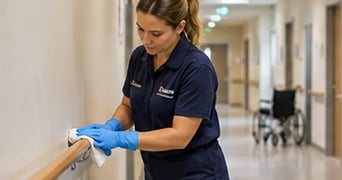
Under the strengthened Aged Care Quality Standards, aged care cleaning has two jobs. The environment has to be “routinely cleaned and well-maintained”. Cleaning also has to be part of the provider’s infection prevention and control (IPC) system. In practice that means a documented, risk-based cleaning schedule with neutral detergent for routine cleaning, disinfectant where there is contamination or a known or suspected infection, more frequent cleaning during outbreaks, and records and audits that show it is being done.
This guide covers residential and other centre-based aged care settings. Cleaning in a person’s own home under home care is a different service and is covered by a separate outcome in the Standards.
What the strengthened Quality Standards require
The strengthened Aged Care Quality Standards started on 1 November 2025, alongside the Aged Care Act 2024. There are seven standards. Cleaning sits mainly in Standard 4: The Environment. Its intent states that effective infection prevention and control measures are a core part of service delivery to protect older people.
Outcome 4.1b – Environment (services delivered other than in the individual’s home) requires a clean, safe and comfortable environment. The actions include that the service environment is:
- routinely cleaned and well-maintained
- safe, welcoming and comfortable
- fit-for-purpose.
Action 4.1.3 adds that equipment used in delivering care is safe, clean and well-maintained.
Outcome 4.2 – Infection prevention and control requires an appropriate IPC system, and that aged care workers use hygienic practices and take appropriate precautions. The system must, among other things:
- identify an appropriately qualified and trained IPC lead
- describe standard and transmission-based precautions for the setting, including cleaning practices
- make sure personal protective equipment (PPE) is available to aged care workers, older people and others who may need it
- include additional precautions to respond promptly to novel viruses and outbreaks of infectious disease.
Antimicrobial stewardship sits separately, in Standard 5 (Clinical Care), Outcome 5.2.
The Aged Care Quality and Safety Commission points providers to the Australian Commission on Safety and Quality in Health Care (ACSQHC) for environmental cleaning resources. The main one is The Aged Care Infection Prevention and Control Guide (ACSQHC, August 2024). Chapter 6 of that guide covers environmental cleaning, and most of the detail below comes from it.
Cleaning and disinfection: the basics
The ACSQHC guide separates the two:
- Cleaning uses neutral detergent, water and physical scrubbing to remove dirt and microorganisms from surfaces. This is the routine method.
- Disinfection uses a chemical to kill most remaining microorganisms. It only works on a surface that is already clean. It is needed when a surface may be or is known to be contaminated, or when transmission-based precautions apply.
The guide is clear that disinfectants are not to be used as routine cleaning products unless combined with a neutral detergent. Spraying a product and wiping without scrubbing is not effective.
When disinfection is needed, there are two accepted methods:
- Two-step clean: clean with neutral detergent and water, then apply disinfectant.
- Two-in-one clean: use one product that contains both a neutral detergent and a disinfectant, with physical scrubbing.
In both cases the surface must be left to dry completely. Disinfectants used in healthcare must be listed on the Australian Register of Therapeutic Goods (ARTG). In residential and centre-based care, the guide says they must be listed as hospital-grade. Sodium hypochlorite (bleach) works but can damage skin, eyes, surfaces and fabrics, so it needs care. For the general difference between these terms, see cleaning vs sanitising.
Technique: order, direction and colour coding
The guide sets out a consistent method:
- High to low: clean higher surfaces before lower ones.
- Clean to dirty: work from cleaner areas towards dirtier ones, so that toilets and bathrooms come last.
- One direction: wipe in an S-shaped pattern rather than back and forth, so that contamination isn’t spread.
- Colour-coded equipment: use colour-coded cloths, mops and buckets to keep items in their designated areas.
- Launder mop heads and reusable cloths daily, and clean cleaning equipment after each use.
Aged care cleaning frequencies
The ACSQHC guide includes a frequency table (Table 20) with two columns: standard frequency (no known or suspected infection) and high-risk frequency (known or suspected infection or outbreak). It says the recommended frequencies should be followed as much as is reasonably practicable. A selection:
| Item | Standard frequency | Infection or outbreak |
|---|---|---|
| Doorknobs | Daily | Twice daily |
| Bedside table | Daily | Twice daily and after each use |
| Bedroom horizontal surfaces (e.g. ledges) | Twice daily; spot clean after use | Same |
| Polished floors | Dust removal and cleaning daily | Twice daily |
| Shower | Daily, plus one daily spot check | Same |
| Commode | Contact points after use; whole commode daily | Same |
| Bed | Frame daily; underneath weekly | Same |
| Call bell | Daily | Daily |
| Computers, devices, keyboards | Daily, when visibly soiled or after use | Twice daily, when soiled or after use |
| Mobility aids (walkers, wheelchairs, sticks) | Daily and after use | Same |
| Hoists and manual handling equipment | Contact points after use | Same |
| Medication and dressing trolleys | Daily and after use | Same |
| Sharps bin trolley and brackets | Daily | Twice daily |
| Curtains and blinds | Monthly; change when soiled, damaged or at terminal clean | Weekly; same change rules |
| Ceiling | Spot clean daily; wash yearly | Same |
| Cleaning equipment | After each use | After each use |
The guide also says frequently touched surfaces such as door handles and light switches need cleaning at least daily, and more often when visibly soiled.
Who cleans what
Many of these items are cleaned by care staff, not cleaners. Examples are blood pressure cuffs after each use, hoist contact points and clinical equipment between residents. The guide says organisations must document the reprocessing process for each piece of equipment, say who is responsible, and make sure those people are trained. A good schedule splits the work clearly:
- Cleaning team: resident rooms, ensuites, common areas, dining rooms, corridors, floors, toilets, high-touch points, curtains and blinds on cycle, terminal cleans.
- Care and clinical staff: shared clinical equipment between residents, mobility aids after use (unless assigned to cleaners), spills during care.
- Kitchen and laundry: under their own food safety and laundry procedures.
Spills of blood and body fluids
The ACSQHC guide says spills should be removed promptly, then the area cleaned and disinfected. The method depends on size:
- Spot cleaning for small drops.
- Small spills (up to 10 cm diameter): wipe up with absorbent material, clean with neutral detergent solution, then wipe with a TGA-listed disinfectant.
- Large spills (over 10 cm diameter): cover with an absorbent clumping agent and scoop it up, mop with neutral detergent solution, then wipe with a TGA-listed disinfectant.
Keep spill kits with disposable components in higher-risk areas. Make sure every cleaner and care worker knows where they are and who restocks them.
Terminal cleaning
The guide defines a terminal clean as the cleaning and disinfection needed after an older person has left a room. The steps include:
- wearing the right PPE
- removing curtains for laundering
- cleaning and disinfecting all surfaces in the room and bathroom
- cleaning reusable equipment once finished.
Agree in advance who calls for a terminal clean, how quickly it is needed, and who signs off the room as ready.
Cleaning during an outbreak
Outbreaks change the schedule. Under Table 20, high-touch items move to twice daily, and disinfection is added because transmission-based precautions apply. Your IPC lead should decide when outbreak frequencies start and stop. Your cleaning provider needs to be able to scale up at short notice.
In NSW, NSW Health describes a suspected gastroenteritis outbreak as two or more people with sudden onset of vomiting or diarrhoea at the one time in an institution. Aged care facilities must notify their local public health unit, which can be reached on 1300 066 055.
Practical outbreak steps for the cleaning team:
- move to the outbreak frequencies in the schedule and confirm with the IPC lead
- use a disinfectant suited to the likely organism, applied after detergent cleaning or as a two-in-one product
- keep dedicated equipment for affected areas and clean affected rooms last
- record every extra clean
- terminal clean rooms when residents come out of isolation.
Documentation, training and audits
The ACSQHC guide states that all organisations should have a documented cleaning schedule setting out responsibilities, rosters, frequencies and products. It also says:
- outsourced cleaning procedures must be documented too
- all cleaning staff, including contractors, should receive initial and ongoing training in IPC basics, product selection, storing solutions and PPE, and training records should be kept
- environmental cleaning audits check that cleaning is done to a high standard. They combine visual checks with objective methods, and results are fed back to staff.
Records like these are how a provider shows the Aged Care Quality and Safety Commission that Outcomes 4.1 and 4.2 are being met in practice.
What to ask an aged care cleaning provider
If you outsource some or all cleaning, ask:
- Will you work to our IPC system and cleaning schedule, including the ACSQHC standard and outbreak frequencies?
- What IPC training have your cleaners had, and can you show training records? Will relief staff be inducted the same way?
- Which detergents and disinfectants will you use? Are the disinfectants ARTG-listed and hospital-grade? Can we see the safety data sheets?
- Do you use colour-coded equipment, and how are mop heads and cloths laundered?
- How do you handle terminal cleans and spills, and how fast can you respond?
- How will you increase cleaning during an outbreak, and who do we call after hours?
- How do you record completed cleans, and how often do supervisors audit the site?
- How will cleaners work around residents, including people living with dementia, so that routines, privacy and dignity are respected?
Frequently asked questions
What are the aged care cleaning standards in 2026?
The strengthened Aged Care Quality Standards have applied since 1 November 2025, alongside the Aged Care Act 2024. Cleaning sits mainly in Standard 4 (The Environment): Outcome 4.1 requires a routinely cleaned, well-maintained environment and Outcome 4.2 requires an infection prevention and control system that includes cleaning practices. The ACSQHC Aged Care Infection Prevention and Control Guide gives the practical detail, including recommended cleaning frequencies.
What are the duties of a cleaner in aged care?
Typically, cleaning residents’ rooms and ensuites, common and dining areas, corridors, floors and toilets, high-touch points, curtains and blinds on a cycle, and terminal cleans when a resident leaves a room. Cleaners also follow the IPC lead’s instructions during outbreaks. Shared clinical equipment is often cleaned by care staff, so the split should be documented.
Do aged care homes have to use disinfectant every day?
No. Routine cleaning uses neutral detergent and water. Disinfectant is added where contamination is likely or known, or when transmission-based precautions apply, for example during an outbreak. In residential care, disinfectants must be listed on the ARTG as hospital-grade.
What is surface cleaning in aged care?
It is the routine physical cleaning of surfaces with neutral detergent, water and scrubbing to remove dirt and microorganisms, working high to low and clean to dirty. Frequently touched surfaces such as door handles and light switches should be cleaned at least daily. Disinfection follows only where the risk calls for it.
Turn your IPC schedule into a cleaning scope
If you’re outsourcing some or all of your cleaning, B&K Services provides aged care cleaning in Sydney, Wollongong and the Illawarra and Nowra and the Shoalhaven. Bring your cleaning schedule and IPC requirements to a free site walk-through. We agree the scope, frequencies, timing and who cleans what in writing before work starts, then run scheduled quality checks with a dedicated account manager. Our teams complete WHS induction, safe chemical handling training and site-specific risk assessments. If you also manage a GP or allied health practice, see our medical centre cleaning checklist. Request a free quote or call 1300 136 954.
Summary
Pest control is crucial for businesses to prevent health risks, property damage, and reputation loss. Australia has many pests like termites, ants, and cockroaches, making regular pest management essential. Commercial properties should have pest control every three months, while food businesses may need monthly treatments. The frequency depends on factors like business type, location, and past infestations. DIY pest control is cheaper but less effective, time-consuming, and risky, whereas professional services ensure safe and long-lasting results. With over 30 years of experience, B&K Services provides expert pest control solutions to keep your property pest-free. Contact them today!