1300 136 954
 info@bnkservices.com.au

Read Time: 9 Min
Childcare Deep Cleaning: What's Included and When Should You Book It?

A childcare deep clean includes whatever periodic work you write into the scope: the rooms, surfaces and items your routine clean doesn't reach, with each task assigned to either the contractor or your own team. Book it when room condition or staff notes show build-up that routine cleaning isn't clearing, and schedule it for a window when those rooms can stay child-free until the work has been checked. That is usually after close, over a weekend or during a planned closure.
Here's the difference in practice. Your routine clean vacuums the toddler room carpet every night. Periodic work is the carpet extraction that lifts the soil a vacuum leaves behind. That job needs furniture moved, time to dry and a check before children return, so it needs its own booking. NHMRC's Staying healthy guidelines treat both as necessary: "Carpets and mats should be vacuumed daily and steam cleaned at least every 6 months" (NHMRC: A healthy environment).
This guide covers the periodic side. For daily, weekly and educator tasks, see our childcare cleaning checklist.
Routine hygiene, periodic work and outbreak response are different jobs
Keep three kinds of cleaning separate when you plan a deep clean, because they have different owners and different triggers.
- Routine hygiene follows your centre's procedures every day. NHMRC says "Toys must be washed at the end of every day", and nappy change surfaces are cleaned after each change and at the end of each day (NHMRC). A periodic deep clean doesn't replace any of this.
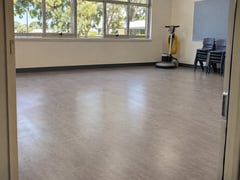
- Periodic contractor work is planned, scoped and booked: carpet extraction, machine floor scrubbing, high and detailed surfaces, glass, and items moved out of the way so the areas behind them can be reached.
- Outbreak response is directed by health authorities. NHMRC states: "If there is a disease outbreak, your local public health unit will advise on cleaning procedures" (NHMRC). Follow that advice rather than assuming every illness calls for a whole-centre deep clean.
Only the middle branch belongs in a deep-clean booking. The other two keep running on their own owners and triggers.
If you use an external cleaner, NHMRC also says to "tell its cleaning staff about the requirements in Table 3.1", the guidelines' table of what to clean and when (NHMRC). A written scope is the practical way to do that.
What should go in a childcare deep-clean scope?
Start with a walk-through. Look at floor edges and corners, under and behind furniture, high ledges and vents, glass, grout, and carpet in traffic lanes. Separate what the routine clean is missing (a quality issue for your existing schedule) from work that genuinely sits outside it (periodic scope).
Then record each item room by room. The table shows what to discuss for each area. It lists possibilities to consider, not a standard package.
| Area | Periodic work to discuss | Who handles it or what to confirm | Access or handover consideration |
|---|---|---|---|
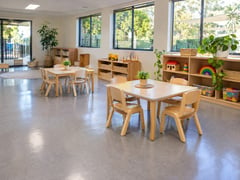
| Playrooms | Detail cleaning of shelf tops, skirting, window ledges and surfaces behind movable storage. Machine scrubbing of suitable hard floors. | Toys: routine toy washing stays with your team. If you want the contractor to clean a batch of toys, list which ones and how they're cleaned, and exclude electronic, porous or specialist resources unless agreed. Furniture: confirm who empties shelves, who moves storage units and who returns resources to their places. | The room must be empty of children. Allow time for educators to reset learning materials before the next program. |
| Sleep and rest areas | Cot frames, mattress covers, under-cot floors and stacked-stretcher storage. | Bedding: wiping cot frames isn't laundering linen. Confirm who strips and remakes beds and who launders bedding. NHMRC requires laundered items to be dried "completely before storing them or using them again" (NHMRC). | Rest rooms are often needed early. Make sure bedding is dry and back in place, and cots are reset, before the room's first rest period. |
| Bathrooms and nappy-change areas | Detail scrubbing of floor edges, grout and the surrounds of fixtures, beyond the routine wipe-down. | Change areas: educators still clean after each change. Confirm which surfaces, fixtures and edges the periodic work covers, and the products to be used where your procedure specifies them. | If the centre stays open, keep at least one change area and child toilet available, and agree which one before work starts. |
| Food-service areas | Splashbacks, appliance exteriors and surrounds, cupboard fronts, floor edges under equipment. | Food and equipment: confirm whether appliance interiors or food-contact equipment are included. Decide who removes food, clears cupboards and moves appliances. Your food-safety obligations stay with the centre. | Schedule around meal preparation. The kitchen must be reset and checked before the next service. |
| Carpeted and shared spaces | Carpet extraction, rugs, upholstery or removable cushion covers, entry mats, internal glass. | Carpet: confirm the method proposed, which carpets and rugs are included, and who moves and replaces furniture. NHMRC says floor cushions should have removable covers, which are washed rather than extracted (NHMRC). | Carpet must be dry before the room is used. Confirm how drying will be checked and what happens if a room isn't ready. Keep family routes away from the work. |
Before you approve the scope, confirm four things in writing:
- Inclusions and exclusions for each room, including whether toys, bedding or appliance interiors are in or out.
- Preparation: what your team must clear, move or protect before the contractor arrives.
- Method for any carpet, upholstery or floor treatment, and the products to be used.
- Handover: who checks each room, what they check and who decides it can be used again.
When should a childcare centre book a deep clean?
Book from evidence rather than habit. These are the practical triggers.
- Room condition: soil building up along carpet traffic lanes, dull or grimy hard floors, marked walls and skirting, dust on high ledges and vents.
- Recurring issues recorded by staff: the same odour, stain or grime returning after routine cleaning. If educators keep logging it, the routine schedule isn't reaching it.
- Planned closures: holiday closures, public holidays and staff training days give you whole days with rooms empty. They're the easiest time for work that needs drying time.
- Occupancy: low-attendance days or rooms not in use let you take one area offline without closing the centre.
- Contractor access: key or alarm arrangements, after-hours windows and lock-up steps all need to be agreed before a date is confirmed.
The first two branches tell you a deep clean is needed. The last three tell you when it can happen.
Your schedule is not the same as an official requirement. Some NHMRC guidance sets item-specific frequencies, such as daily vacuuming and steam cleaning carpets at least every six months. Most deep-clean timing is a choice your centre makes based on use, condition and access. A plan of term or quarterly periodic work is a sensible schedule, but it's your service's decision, not a regulation. When you set it, record the reason, such as condition, recurring issues or the item's own guidance, so it can be reviewed.
Example: carpet extraction in a room needed the next morning
This is a hypothetical example, not a B&K client case.
A centre has two wings. On a Thursday the director keeps the east wing open and takes the west wing's toddler room out of use for the afternoon. The original request is hard-surface detailing in that room after the last children leave the wing, which suits a short evening window.
Then the director adds carpet extraction to the same room, which is needed at 7 am on Friday. That changes the booking:
- The window moves earlier or gets longer. Furniture must come out before extraction starts, and the carpet needs ventilation and time to dry before the room reopens. The director either releases the room earlier on Thursday or moves the carpet work to Friday after close, with the weekend for drying.
- A fallback is planned. If the carpet is booked for Thursday, the director names a back-up room for the toddler group in case the carpet isn't ready by morning.
- The scope grows. It now lists the carpet areas, who moves the furniture, ventilation arrangements and an opening-time check.
Drying depends on the carpet, the method, airflow and the weather, so no contractor can promise a fixed reopening time without assessing the room. Before the toddler room is released on Friday morning, the director or a named staff member confirms:
- the carpet is dry to the touch across the room, including under the edges of returned furniture
- there is no strong residue odour, and products and equipment have been removed
- furniture and resources are back in their agreed positions and stable
- any part of the scope that wasn't completed is recorded, with a plan to finish it
If any of these isn't met, the back-up room is used and the toddler room stays closed until it is.
Planning a childcare deep clean with B&K Services
B&K Services cleans childcare centres across Greater Sydney, Wollongong and the Illawarra, and Nowra and the Shoalhaven. Deep cleaning, carpet care, machine floor scrubbing and window cleaning can be scheduled separately from routine cleaning, including during holiday closures. Cot and bedding tasks, and toy cleaning, are included only where they're agreed in the scope. B&K walks through the centre and drafts a room-by-room scope with task frequencies, and your centre's procedures and product requirements can be written into it.
To start, send us:
- which rooms need attention, and what you've noticed in each
- the work you want included, such as carpets, hard floors, glass, toys or bedding, and anything your team will keep
- when those rooms are available, and which areas must stay open
Find out more about our childcare cleaning in Sydney, Wollongong or Nowra.
Sources
- National Health and Medical Research Council, Staying healthy: A healthy environment.
Summary
Pest control is crucial for businesses to prevent health risks, property damage, and reputation loss. Australia has many pests like termites, ants, and cockroaches, making regular pest management essential. Commercial properties should have pest control every three months, while food businesses may need monthly treatments. The frequency depends on factors like business type, location, and past infestations. DIY pest control is cheaper but less effective, time-consuming, and risky, whereas professional services ensure safe and long-lasting results. With over 30 years of experience, B&K Services provides expert pest control solutions to keep your property pest-free. Contact them today!