1300 136 954
 info@bnkservices.com.au

Read Time: 9 Min

Sustainable commercial cleaning means keeping a workplace hygienic while reducing the environmental and health impact of how it is cleaned: the chemicals used, how much water and energy goes into the job, how much waste comes out of it, and how safely the people doing the work are managed.

It is not a product swap. A contractor can buy a “green” spray and still over-dose it, tip the bucket into a stormwater drain and send a skip of single-use wipes to landfill. The useful question for a facility or property manager is not “do you use eco products?” but “what do you do differently, and can you show me?”
This guide covers what a sustainable cleaning program should include, the Australian rules worth knowing, and the questions to put to a provider before you sign.
What sustainable commercial cleaning covers

A credible program addresses six areas. If a provider only talks about the first one, keep asking.
1. Products: fewer, better-chosen chemicals
- A short product list. Most commercial sites can be cleaned with a small range: a neutral detergent, a bathroom cleaner, a glass cleaner, a floor product and, where needed, a disinfectant. Fewer products means less packaging, less storage risk and less confusion for cleaners.
- Independently certified products where practical. In Australia the main independent ecolabel for cleaning products is Good Environmental Choice Australia (GECA). Ask which products on the provider’s list hold a current licence. Our guide to choosing eco-friendly cleaning products explains what the label covers and how to check a product’s claims.
- Concentrates with controlled dilution. Concentrates cut packaging and freight, but only save anything if they are diluted correctly. Dispensing systems or clearly marked dosing are better than “a splash”.
2. Methods: doing more with less chemical
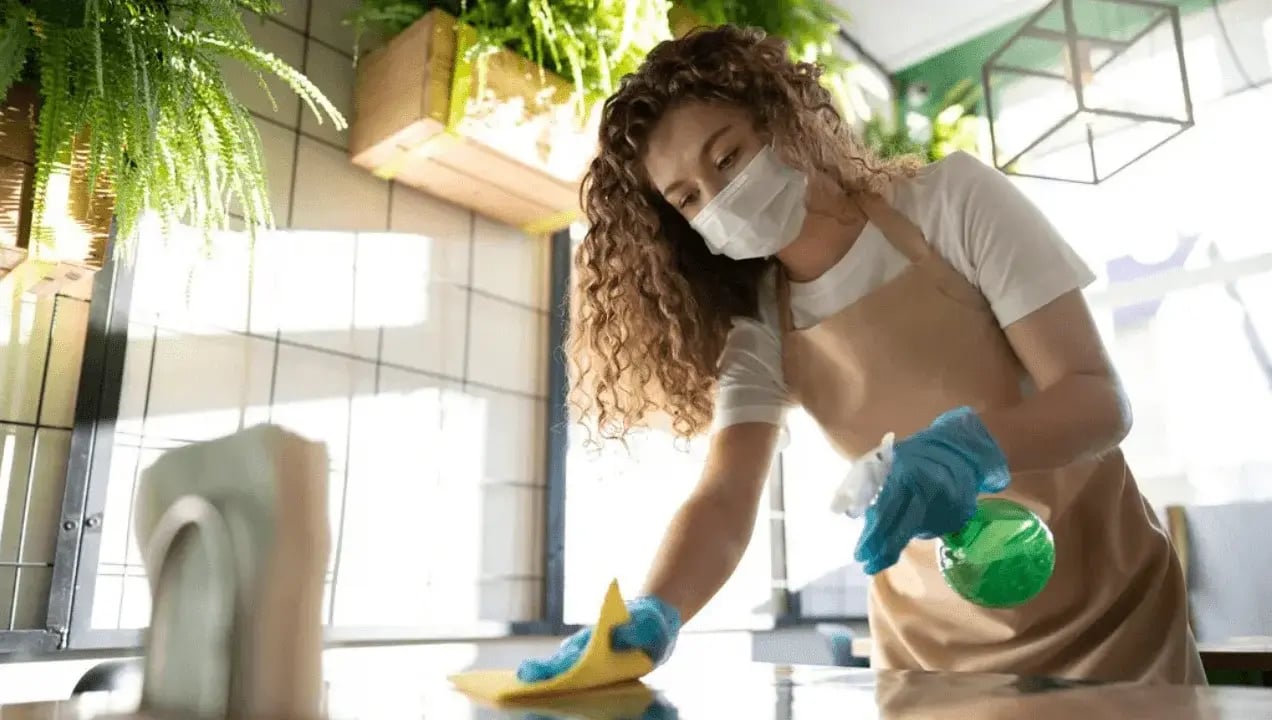
- Microfibre cloths and mops that are laundered and reused, instead of disposable wipes.
- Colour-coded equipment (for example, separate cloths for bathrooms and kitchens) so cleaning does not spread contamination from one area to another.
- Right task, right product. Daily cleaning of low-risk surfaces usually needs detergent and water, not a disinfectant. Disinfectants should be targeted at the areas and times they are actually needed (see “Green does not mean hygienic” below).
- Damp rather than flood mopping to reduce water use and slip risk.
3. Water
Water savings come mostly from method rather than a single product: concentrates dosed correctly, microfibre that needs less water, damp rather than flood mopping, and scrubber-dryers that pick up water as they go.
Dispose of it properly, too. NSW EPA guidance is blunt: the drain is “just for rain”, and chemicals don’t belong in it. Use dedicated washdown areas that don’t lead to stormwater drains, and use a low-phosphorus detergent sparingly.
4. Waste
- Reduce single-use items (wipes, paper towel in back-of-house areas, disposable mop heads).
- Reuse and launder cloths and mop heads.
- Recycle product packaging and, where the site has the bins and the building’s waste contractor supports it, separate recycling and organics correctly when emptying bins.
- Ask for simple reporting if your building or organisation tracks waste diversion.
5. Equipment
Well-maintained vacuums, scrubbers and other machines use energy and water more efficiently and last longer. Ask about filtration on vacuums for indoor air quality, battery equipment for quieter after-hours work, and how equipment is serviced.
6. People and safety
Sustainability includes the people doing the work. A good provider trains cleaners in product use, dilution, chemical handling and storage, and keeps the safety paperwork required under work health and safety (WHS) laws (see below). GECA’s cleaning services standard, for example, treats training in safe chemical handling and equipment use, waste and water management, and fair treatment of workers as part of what makes a cleaning service environmentally preferable.
Green does not mean hygienic – and it does not have to mean less hygienic
The biggest trap in “eco” cleaning is assuming a gentle product does the same job as a disinfectant. It may not. In Australia, disinfectants are covered by a Therapeutic Goods Order, TGO 104, and any claim to kill particular organisms must be supported by testing.
For a cleaning contract, that means:
- Cleaning first, disinfecting where needed. Detergent cleaning removes dirt and grime; disinfection is a separate step, added where your procedures or sector guidelines call for it. Our article on the difference between cleaning and sanitising explains this further.
- Don’t swap a disinfectant for a “natural” product in areas where your procedures or sector guidelines require disinfection (for example, medical, aged care or childcare settings, or food preparation areas). Choose a disinfectant whose label claims suit the task, and use it at the stated dilution and contact time.
- Steam and other chemical-free methods can reduce chemical use on some surfaces, but check they meet your site’s hygiene requirements before relying on them in place of a disinfectant.
Sustainability and hygiene work together when disinfectant use is targeted rather than routine on every surface.
The WHS side: safety data sheets and the chemical register
“Eco-friendly” products can still be hazardous chemicals under WHS laws. Under the model WHS laws, as summarised by Safe Work Australia:
- Manufacturers and importers must prepare a safety data sheet (SDS) for each hazardous chemical and review it at least every five years.
- A business or undertaking that uses, handles or stores hazardous chemicals must keep a hazardous chemicals register at the workplace, containing the current SDS for each chemical, and keep it readily accessible to workers and emergency services.
- There are limited exceptions, such as consumer products used in quantities and a manner consistent with household use.
Safe Work Australia’s register fact sheet gives the example of contracted cleaners in an office: the office keeps the register and current SDSs, and the cleaning company still has to give its own workers information about the chemicals. So when you engage a contractor, ask for the SDS of every product they will bring on site and agree where the register is kept. A provider that cannot produce current SDSs on request has a gap, whatever its marketing says.
Testing a provider’s green claims
The ACCC’s eight principles for environmental claims say, in short, that claims must be accurate, backed by evidence, clearly explained and not broad or unqualified. Apply that to a cleaning provider’s pitch:
- Vague: “we use green products”, “eco-friendly cleaning”, “chemical-free”. Ask what that means on your site.
- Better: a product list with SDSs, named certifications for specific products, and practices you can see during a site visit.
- Check certificates yourself. A provider’s GECA Cleaning Services certification or ISO 14001 (environmental management) certificate can be verified with the certifier. Ask for the certificate, scope and expiry date.
What to ask a cleaning provider
Use these questions in a quote request, tender or contract review:
- Which products will you use on our site? Please provide the list and current SDSs.
- Which of those products are independently certified, and by whom?
- How are products diluted and dispensed?
- Where will you use disinfectant, and which product? Does its label claim suit the task?
- Do you use reusable microfibre and colour-coded equipment? How is it laundered?
- How is wash water disposed of on our site?
- How will you reduce single-use consumables, and can you report on waste or consumable use if we need it?
- What training do your cleaners receive in chemical handling and safe work?
- Do you hold any environmental management certification (such as ISO 14001)? Please provide the certificate and scope.
- How will you check quality and report issues, so that greener methods don’t come at the expense of cleaning standards?
Write the answers into the scope of works, so the practices are part of the contract rather than a sales promise.
Matching sustainability to your site type
- Offices: usually the easiest place to cut chemical use: detergent and microfibre for most surfaces, targeted disinfection of touchpoints, kitchens and bathrooms. See our office cleaning service.
- Strata and residential common areas: focus on water disposal, waste room cleaning and products safe for shared spaces.
- Healthcare, aged care and childcare: sector infection-control requirements come first; sustainability improvements sit within them (for example, reusable microfibre and correct dilution) rather than replacing required disinfection.
- Warehouses and industrial sites: water and energy use from machine scrubbing, and correct disposal of wash water, usually make the biggest difference.
Frequently asked questions
What certification should a sustainable cleaning provider hold?
No certification is mandatory. GECA’s Cleaning Services standard certifies cleaning service providers, and ISO 14001 is the common certification for an environmental management system. Ask for the certificate itself and check its scope and expiry with the certifier.
Does sustainable commercial cleaning cost more?
It depends on the site and scope. Concentrates, reusable microfibre and fewer single-use consumables can offset higher product prices, while certified products or extra reporting can add cost. Ask for a quote that sets out the scope clearly so you can compare like with like.
Which cleaning practices reduce water use on a commercial site?
Correctly dosed concentrates, microfibre cloths and mops, damp rather than flood mopping, and scrubber-dryers that recover water as they clean. Ask a provider which of these they will use on your site and write them into the scope.
Can a cleaning contractor help with our ESG or sustainability reporting?
Possibly, if you agree what will be measured before the contract starts. Useful items include the product list, consumable use and waste or recycling figures. Ask the provider what they can actually report, how often, and in what format.
Building sustainability into your next cleaning contract

If you are about to tender or renew, the questions above work best when the answers end up in the written scope. B&K Services provides commercial cleaning across Sydney, Wollongong and the Illawarra, and Nowra and the Shoalhaven. Eco-friendly practices and responsible waste management are part of our standard approach, and our teams complete WHS induction and safe chemical handling training.
We start with a free site walk-through, then agree scope, frequency, timing and responsibilities in writing, so your sustainability requirements sit in the contract rather than in a sales pitch. Read more about how we work and our commercial cleaning service, or contact us on 1300 136 954.
Summary
B&K Services provides eco-friendly commercial cleaning solutions in Australia, using biodegradable products, sustainable practices, and innovative technologies to promote a healthier environment. With over 30 years of experience, their services reduce carbon footprints, improve indoor air quality, and enhance employee well-being, while aligning with businesses’ sustainability goals.
Offering tailored cleaning plans, flexible scheduling, and affordable packages, B&K Services uses advanced, energy-efficient equipment to ensure exceptional results. Their commitment to quality and environmental responsibility makes them a trusted partner for businesses seeking greener, cleaner workspaces.