1300 136 954
 info@bnkservices.com.au
Read Time: 16 Min
Medical centres, allied health practices and aged care facilities should use a hospital-grade disinfectant, and Australian healthcare guidance asks for one that is TGA-listed with specific claims. Childcare services should buy disinfectant labelled hospital-grade or similar. Offices, gyms and most school areas are usually well served by detergent cleaning, with a household/commercial-grade disinfectant used only where it is needed.
Whatever your setting, the grade matters less than how the product is used. Disinfectant goes on a surface that has already been cleaned with detergent. It is used for a reason, such as a body fluid spill or an outbreak, and it stays wet for the contact time on the label.
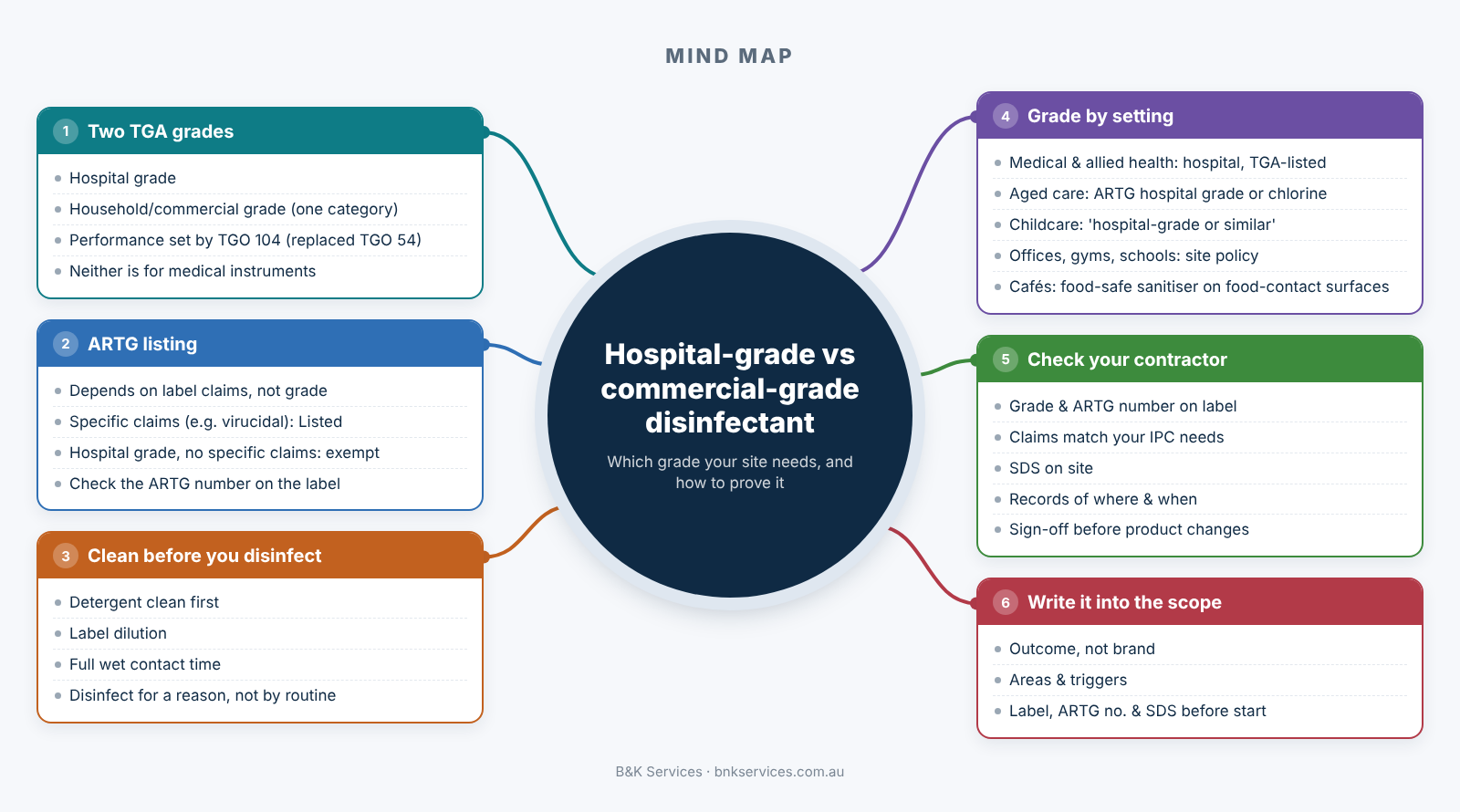
Hospital-grade vs commercial-grade disinfectant, at a glance
Quick answer: which disinfectant grade fits your setting?
| Setting | Grade to specify | What the guidance says | When to disinfect |
|---|---|---|---|
| Medical centres and allied health | Hospital grade, TGA-listed with specific claims | NHMRC infection control guidelines | After detergent cleaning, where contamination is suspected or known |
| Aged care (residential and centre-based) | Hospital grade, listed on the ARTG (or a chlorine-based product) | Aged Care IPC Guide | After detergent cleaning, where contamination is possible or known, or transmission-based precautions apply |
| Childcare | Labelled “hospital-grade” or similar | NHMRC Staying Healthy | Body fluid spills, nappy change surfaces, outbreaks |
| Schools | No national grade rule; decide by area | Site policy | Body fluid spills, illness clusters, high-risk areas |
| Offices | Household/commercial grade is usually enough | Site policy | High-touch points as scoped, spills, illness |
| Gyms | Household/commercial grade, or hospital grade if your policy asks for it | Site policy | Shared equipment, change rooms, body fluid incidents |
| Cafés, restaurants and food premises | A sanitiser suitable for food-contact surfaces; disinfectant elsewhere as needed | Food Standards Code, Standard 3.2.2 | Food-contact surfaces cleaned and sanitised; toilets and spills as scoped |
The rest of this guide explains where these answers come from, how to check what your cleaner is actually using, and how to write the requirement into a cleaning scope without naming a brand.
What is the difference between hospital-grade and commercial-grade disinfectant?
In Australia, hard-surface disinfectants are regulated by the Therapeutic Goods Administration (TGA). The TGA recognises two grades for these products: hospital grade and household/commercial grade. Commercial grade is not a separate legal category. It sits in the same group as household grade.
The performance and labelling rules for both grades are set by the Therapeutic Goods (Standard for Disinfectants and Sanitary Products) (TGO 104) Order 2019. TGO 104 has separate performance requirements for hospital-grade and household-grade disinfectants. In plain terms, a product has to meet the hospital-grade performance requirements before it can be sold under that name.
You may still see older material refer to TGO 54. The NHMRC notes that TGO 54 was superseded by TGO 104 on 1 April 2019, so TGO 104 is the current standard.
The label also tells you which grade you have. The TGA says household and commercial grade disinfectants must not be labelled “hospital grade”, or use words that imply they are.
| Hospital grade | Household/commercial grade | |
|---|---|---|
| Performance standard | Hospital-grade requirements in TGO 104 | Household-grade requirements in TGO 104 |
| Can say “hospital grade” on the label | Yes | No, and must not imply it |
| On the ARTG? | Yes if it makes specific claims; exempt if it does not | Yes if it makes specific claims; exempt if it does not |
| For use on medical devices or instruments | No | No |
That last row matters for clinics. Hard-surface disinfectants of either grade are not intended for use on medical devices. Instrument reprocessing is a separate, clinical task, and it is not part of an environmental cleaning contract.
Does a hospital-grade disinfectant have to be on the ARTG?
Not always. Whether a hard-surface disinfectant is entered on the Australian Register of Therapeutic Goods (ARTG) depends on what the label claims, not on its grade. The TGA explains that household/commercial-grade and hospital-grade hard-surface disinfectants with specific claims are Listed therapeutic goods, while hospital-grade hard-surface disinfectants with no specific claims are exempt from needing an ARTG entry.
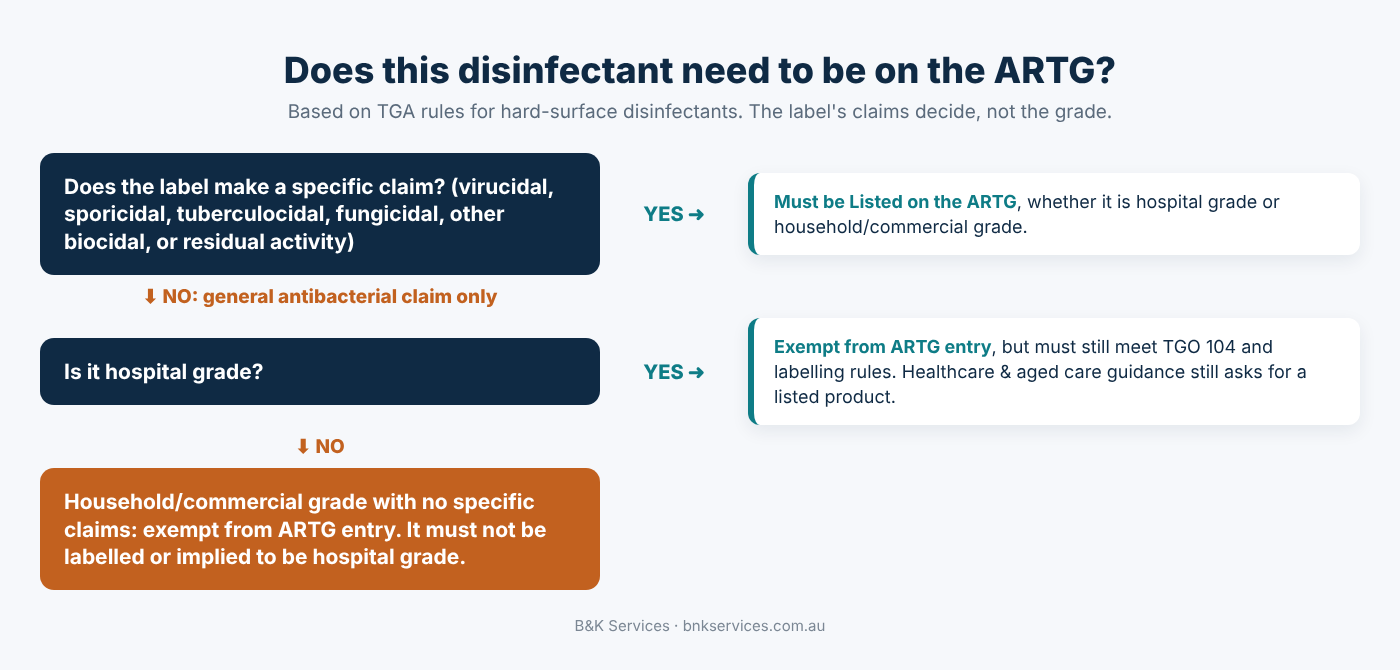
“Specific claims” are claims of virucidal, sporicidal, tuberculocidal, fungicidal or other biocidal activity. A claim of residual activity, such as protection for a set number of hours, also counts as a specific claim. A general antibacterial claim does not.
This clears up two common mistakes:
- No ARTG number does not mean the product isn’t hospital grade. A hospital-grade product with no specific claims can lawfully be supplied without an ARTG entry. Exempt products must still meet all regulatory requirements, including labelling.
- An ARTG number does not make a product hospital grade. A commercial-grade product that claims to kill viruses also needs to be listed. Read the grade on the label, not just the number.
Many supplier pages still say every hospital-grade disinfectant must be ARTG-listed. That is not what the TGA says.
Where the rules and sector guidance differ
There is one point to watch here. The law allows some hospital-grade products to sit outside the ARTG, but healthcare and aged care guidance asks for a listed product. The NHMRC recommends TGA-listed hospital-grade disinfectants with specific claims for hard surfaces in healthcare facilities. The Australian Commission on Safety and Quality in Health Care’s aged care guide says disinfectants in residential and centre-based aged care must be listed on the ARTG as a hospital-grade disinfectant.
So for clinical and aged care sites, the practical answer is simple: specify a hospital-grade product that is listed on the ARTG with the specific claims your infection control lead needs.
Cleaning comes before disinfecting
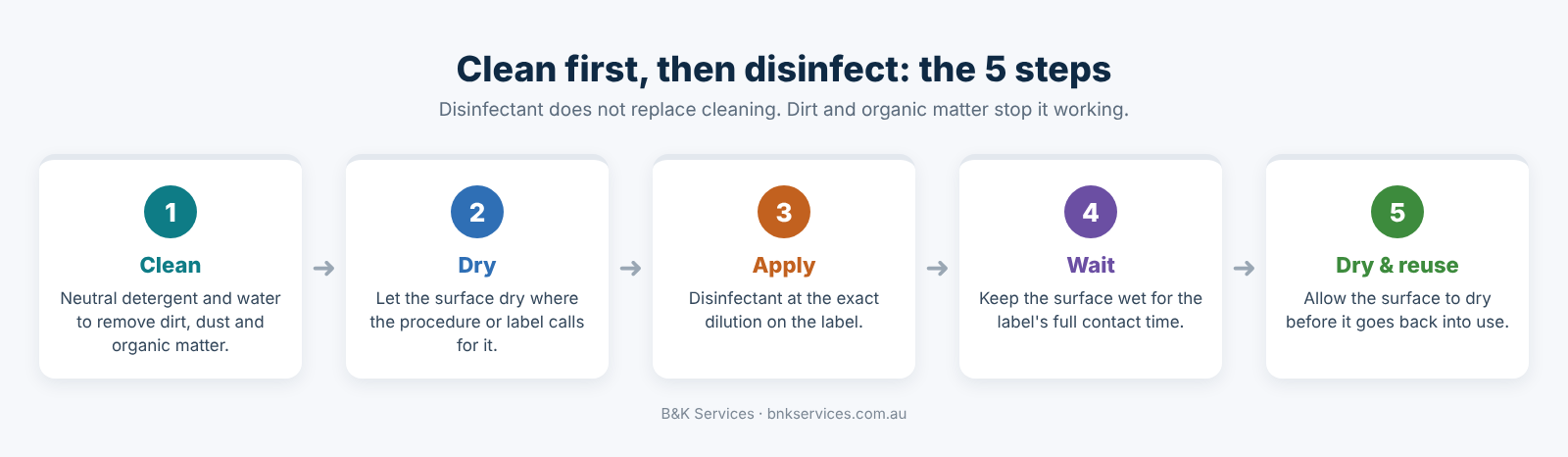
Disinfectant does not replace cleaning. Dirt and organic matter get in the way of the chemical, so the surface has to be clean first. NHMRC’s childcare guidance is blunt about it: you must clean first, before using disinfectant.
Even in healthcare, disinfection is targeted. The NHMRC says disinfectants are usually only necessary when a surface already cleaned with detergent and water is suspected or known to be contaminated, for example by multi-resistant organisms. It adds that they may also be used after routine cleaning during an outbreak, such as gastro. The aged care guide goes further and says disinfectants are not to be used as routine cleaning products.
A correct two-step clean looks like this:
- Clean the surface with neutral detergent and water to remove dirt, dust and organic matter.
- Let it dry where the procedure or label calls for it. The aged care guide asks for surfaces to dry completely before disinfecting.
- Apply the disinfectant at the dilution on the label. Products must be used at the right strength to work.
- Leave it wet for the contact time. The aged care guide says to leave the disinfectant on the surface for the time the manufacturer recommends. Wiping it off early can mean it hasn’t done its job.
- Allow the surface to dry before it goes back into use.
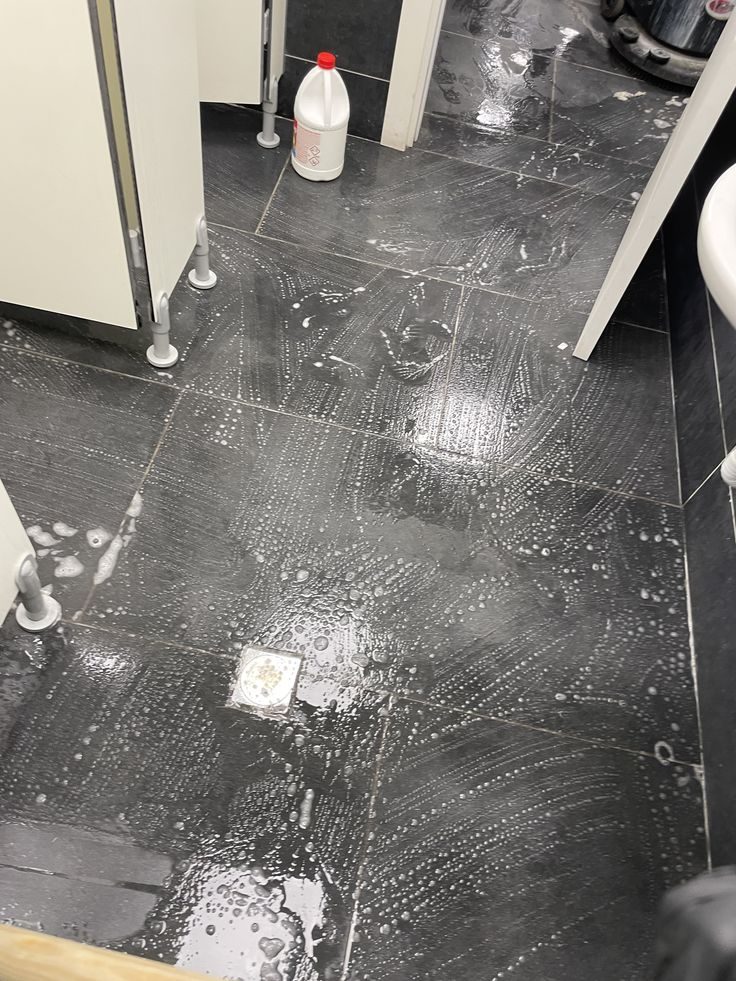
Step one is always a detergent clean. Disinfectant can't work through dirt and organic matter.
Some sites use a combined detergent-disinfectant product instead (a “2-in-1” clean). That is fine where the site’s procedure allows it, as long as the label directions and contact time are followed. For a fuller explanation of the terms, see our guide to the difference between cleaning, sanitising and disinfecting.
Which disinfectant does your business need? Setting by setting
Medical centres and allied health practices
Use a hospital-grade disinfectant that is TGA-listed with specific claims, in line with the NHMRC infection control guidelines. Routine cleaning of waiting rooms, reception and consulting rooms is still done with detergent. Disinfectant is used on top of that where contamination is suspected or known, including blood and body fluid spills, and during outbreaks.
Your practice’s infection control lead decides which claims you need and which rooms or surfaces get disinfected. The cleaning contractor’s job is to deliver that scope consistently. Our medical centre cleaning checklist covers daily and periodic tasks. If you are reviewing your contractor, see B&K’s medical centre cleaning in Sydney, Wollongong and Nowra.
Aged care facilities
The Aged Care IPC Guide is clear: disinfectants used in residential and centre-based aged care should be ARTG-listed hospital-grade products, and chlorine-based products can also be used. Disinfection is needed where a surface may have been, or is known to have been, contaminated by a multidrug-resistant organism, blood or other body fluids, or where transmission-based precautions apply.
Resident safety matters as much as the grade. Choose products your infection control lead has approved, keep each one's safety data sheet on site, follow the label for dilution, ventilation and contact time, and never leave chemicals or trolleys unattended where residents, including people living with dementia, could reach them.
This sits under the strengthened Aged Care Quality Standards, in effect since 1 November 2025. Outcome 4.2 requires providers to have an infection prevention and control system, and your cleaning contractor’s methods need to fit within it. Our aged care cleaning standards checklist goes into more detail. B&K provides aged care cleaning in Sydney, Wollongong and Nowra.
Childcare and early learning centres
NHMRC’s Staying Healthy guidelines say services should purchase disinfectants labelled “hospital-grade” or similar. They also say routine detergent cleaning, followed by rinsing and drying, is the best way to remove germs from hard surfaces. Disinfectant is for body fluid spills, nappy change surfaces that body fluids get onto, and more intense cleaning during outbreaks. Staying Healthy also notes that you do not need bleach for routine disinfection.
For product checks and when to disinfect in a centre, read our guide to cleaning in childcare centres: products and when to disinfect, or see childcare cleaning in Sydney.
Schools
We could not find a national rule that sets a disinfectant grade for general school areas. Most of a school, such as classrooms, corridors and offices, is maintained with detergent cleaning. The sensible approach is to decide by area: disinfect after body fluid spills, in sick bays and first aid rooms, and during illness clusters, using the product and method in the school’s own policy. If the school runs an early learning service, Staying Healthy applies to that part of the site. See school cleaning in Sydney.
Offices
We are not aware of any Australian guidance that requires hospital-grade disinfectant in a standard office. Detergent cleaning, plus a household/commercial-grade disinfectant on agreed high-touch points or after spills and illness, is a reasonable scope. Hospital-grade products are lawful to use in an office if you prefer them, but the grade will not make up for poor method or skipped contact time. Our office hygiene tips cover the daily routine, and B&K’s office cleaning page explains the service.
Gyms and fitness centres
As with offices, no national guidance sets a grade for gyms. The same principle applies: clean shared equipment, mats and change rooms with detergent, and disinfect where there is a reason to, such as body fluid incidents. If your own policy specifies hospital grade, write that into the scope. See gym cleaning in Sydney.
Cafés, restaurants and food premises
Food businesses work to a different rulebook. Under the Food Standards Code, Standard 3.2.2 requires premises, equipment and food-contact surfaces to be kept clean and sanitary. That means cleaning first, then sanitising with heat or a chemical sanitiser that is suitable for food-contact surfaces, used as the label directs. A hospital-grade hard-surface disinfectant is not what the Code asks for on benches and chopping boards, and you shouldn't use one there unless its label says it is suitable for food-contact surfaces.
The NSW Food Authority expects you to be able to show how and when food-contact surfaces are sanitised, so keep a record. Toilets, bins and body fluid spills in a café are handled like any other site: detergent first, then a disinfectant where there is a reason to. Store every chemical away from food, as our guide to how chemicals should be stored in food premises explains, and use our commercial kitchen cleaning checklist to split tasks between staff and cleaners. See restaurant cleaning in Sydney.
Your supplier says you “must” use hospital grade. Do you?
It depends on your setting. If you run a medical centre or aged care facility, the guidance above supports it. If you run an office or gym, ask the supplier which guideline, standard or contract clause requires it. Often the honest answer is your own site policy, not the law.
There is nothing wrong with choosing hospital grade in a lower-risk building. Just make sure the scope also says how and when the product is used. A strong product wiped on and off a dirty surface does less than a commercial-grade product used properly.
How to check what your cleaning contractor is using
A product label and a few documents tell you most of what you need. Ask your contractor for:
- The product name and grade as printed on the label (hospital grade or household/commercial grade).
- The ARTG number, if the product makes specific claims or your sector guidance asks for a listed product. You can search it on the ARTG via the TGA website.
- The specific claims on the label, such as virucidal activity, and whether they match what your infection control lead needs.
- The safety data sheet (SDS) for each chemical used on site.
- Dilution and contact time from the label, and how the cleaners make sure surfaces stay wet for that time.
- Where and when disinfectant is used: which rooms, which surfaces and which triggers (spills, outbreaks, isolation rooms).
- How the work is recorded, so you can show what was done if you are audited.
- How product changes are approved, so a substitute product isn’t introduced without your sign-off.
If you are reviewing a contract more broadly, our commercial cleaning contract checklist covers the chemical list and SDS clause along with scope, term and exit.
How to write disinfectant requirements into a cleaning scope or tender
You don’t need to name a brand. Describe the outcome and the evidence instead. For a clinical area, a requirement might read:
“The contractor will use a hospital-grade hard-surface disinfectant listed on the ARTG with [claims required by the practice], applied after detergent cleaning, at the label dilution and for the label contact time, in [listed areas] and after [listed triggers]. The contractor will provide the product label, ARTG number and SDS before starting, and seek written approval before changing products.”
For an office, the same structure works with “household/commercial-grade disinfectant” and a shorter list of areas and triggers. Writing it this way keeps quotes comparable and gives you something to audit against.
Why online answers about “hospital grade” disagree
Search Reddit or cleaning forums for “hospital grade vs regular disinfectant” and you'll find confident answers that don't apply in Australia. Most come from the US, where “hospital grade” is an EPA term for a broad-spectrum disinfectant that has also been shown to work against Pseudomonas aeruginosa. In Australia the TGA sets the rules: TGO 104 decides what can be labelled hospital grade, and ARTG listing depends on the label's claims, as explained above.
One point does carry across. US trade discussions often conclude that hospital-grade disinfectant isn't needed in a standard office, which matches the Australian guidance for offices in this article.
For practical cleaning questions from other people, browse r/CleaningTips on Reddit. For what is legal and required in Australia, check the product label, the ARTG and the guidance for your sector.
Frequently asked questions
Is commercial-grade disinfectant a separate legal grade?
No. The TGA groups household and commercial grade together. The two TGA grades for hard-surface disinfectants are hospital grade and household/commercial grade.
Can you use hospital-grade disinfectant in an office?
Yes. It is lawful to use anywhere, as long as it is used according to the label. It is not required by any office guidance we are aware of.
Does TGO 54 still apply?
No. TGO 54 was replaced by TGO 104 on 1 April 2019. TGO 104 is the current standard for disinfectants.
Can hospital-grade disinfectant be used on medical instruments?
No. Hard-surface disinfectants are not intended for use on medical devices. Instrument reprocessing is a separate clinical process.
Does every hospital-grade disinfectant have an ARTG number?
No. Hospital-grade hard-surface disinfectants with no specific claims are exempt from needing an ARTG entry. Products with specific claims, such as killing viruses, must be listed.
Which disinfectants are suitable for aged care, and safe for residents?
The Aged Care IPC Guide calls for hospital-grade disinfectants listed on the ARTG, or chlorine-based products, used only after detergent cleaning and where contamination is possible or known. Safety for residents comes from how the product is used: the approved product, the label dilution and contact time, good ventilation, the SDS on hand and chemicals kept out of residents' reach.
Do cafés and restaurants need hospital-grade disinfectant?
Not for food-contact surfaces. The Food Standards Code requires them to be clean and sanitary, which means a sanitiser suitable for food contact, or heat. Use disinfectant on toilets, bins and spills where there is a reason to.
How much does commercial disinfection cost?
It is priced mainly on labour: the area, the number of surfaces, how often, and the time each product needs to stay wet. Targeted disinfection built into a regular clean usually costs less than separate call-outs. Our guide to commercial cleaning costs in Australia explains what drives a quote.
Get the scope right before the next audit
The right disinfectant is the one your setting’s guidance calls for, used on a clean surface, at the right strength, for the full contact time. B&K Services works with medical centres, aged care facilities, childcare centres, schools, offices, gyms and food businesses across Sydney, Wollongong, Nowra and the Shoalhaven, delivering cleaning to a written scope agreed with you.
If you would like to review how disinfection fits into your cleaning scope, request a quote or talk to the B&K team.
Sources
- TGA: Changes to labelling and regulation of hard surface disinfectants
- TGA: Disinfectant claim guide
- TGA: Understanding the rules for exempt disinfectants
- Federal Register of Legislation: TGO 104
- NHMRC: Infection control guidelines FAQ
- NHMRC: Staying Healthy, healthy environment
- ACSQHC: Aged Care Infection Prevention and Control Guide
- FSANZ: Cleaning and sanitising