1300 136 954
 info@bnkservices.com.au

Read Time: 9 Min

To prepare a business for pest control, start by agreeing the scope and any notice periods with your provider. The day before, clear food, clutter and stock away from the areas to be treated and arrange access. Then keep people out of treated areas until the technician says they can return, and tell your cleaners which zones and bait stations to leave alone. The most important rule: follow your licensed technician’s instructions and the product label, because re-entry and cleaning requirements differ by product, method and pest.
Below is a practical checklist for commercial sites, from booking the treatment through to the first week afterwards. It covers the paperwork and notice periods that guides for homes leave out.
Before the treatment: one to two weeks out
Agree the scope in writing
Confirm with your provider:
- which pests are being targeted and which areas will be treated;
- the method (for example baits, monitoring devices, sprays or dusts) and the products to be used;
- whether any areas must be vacated, for how long, and what must be removed or covered;
- what they need from you on access, power, water and keys.
The NSW Food Authority suggests that food businesses using a licensed pest controller get a contract outlining which pests and areas are treated and how often. That is good practice for any site.
Check the licence
In NSW, anyone using pesticides for fee or reward must hold a pest management technician licence from the NSW EPA. NSW Fair Trading advises asking to see a copy.
Ask for safety information
Ask for the safety data sheet (SDS) for each product and for the re-entry instructions on the label. The APVMA notes that SDSs are a requirement under state and territory work health and safety legislation, and that some label instructions are legally binding. Your WHS contact can use these to brief staff.
Build in notice periods
NSW EPA rules can affect your booking date:
- Strata and other multi-occupancy buildings: before common-area treatments, the technician must give all residents at least five working days’ notice (in person, by email, letterbox drop or post) and post notices at entry and exit points and on the main notice board on the day. The person who arranged the service, often the strata manager, must be given the treatment details so residents can be told.
- Childcare centres, preschools, schools, community health centres and nursing homes: at least five working days’ notice is required before spraying or ground-injecting liquid pesticides, or fumigating outdoors, within 20 metres of these sensitive places. Emergencies such as wasps, bees, venomous spiders or rodents allow less notice, but notice must still be given before work starts.
- Baiting programs: notice is needed the first time pesticide is placed in bait stations, and the person arranging the service should be told how long the baits will be in place and where.
Plan the timing
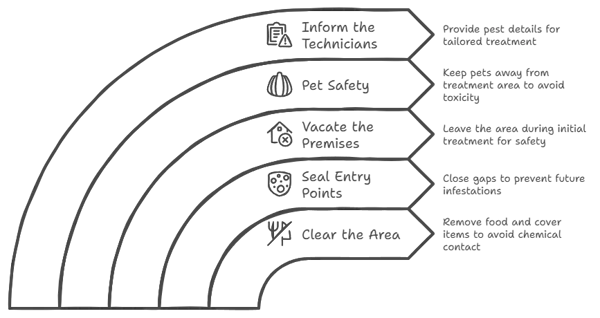
Choose a time when the treated areas are empty, such as after close, on a weekend or before opening. Tell staff, tenants or residents what is happening, which areas are off limits, and who to ask. Let the technician know in advance about anyone on site with health sensitivities or other concerns.
The day before: get the site ready
General checklist (all sites)
- Clean food areas. Remove food residue, grease, crumbs and spills from floors, benches and under equipment. Leftover food is exactly what pests are looking for.
- Empty and clean bins, and tidy waste and recycling areas.
- Declutter. Move cardboard boxes, paper stacks and stored items away from walls, skirting boards and corners so the technician can see and reach them.
- Give access to roof voids, plant rooms, storerooms, risers, basements and external areas, with keys or a staff contact on hand.
- Fix moisture problems you know of, such as dripping taps or leaking pipes, or point them out to the technician.
- Remove or cover food, utensils and personal items in areas to be treated. Better Health Channel (Victorian Government) also advises covering or removing fish tanks and bird cages and relocating pets.
- Write down pest sightings: where, when and what. This helps the technician target the treatment.
Sector checklists
| Site type | Extra preparation |
|---|---|
| Restaurants, cafés, commercial kitchens | Store all food in sealed containers or remove it; clear benches; cover or remove utensils and food-contact equipment as the technician directs; clean behind and under cooking equipment; have your pest log and device map ready. FSANZ says pesticides and devices must be placed where pesticides or dead pests can’t contact food or food-contact surfaces. |
| Offices | Clear food from kitchenettes and desks; empty fridges of open food; clear under-desk clutter and storage areas; tell staff which areas will be off limits. |
| Warehouses | Clear wall lines and aisles; move pallets and stock away from walls where possible; confirm access to dock areas and mezzanines; isolate any stored food or sensitive goods. |
| Strata buildings | Confirm the five-working-day resident notice has gone out; open bin rooms, car parks, plant rooms and common storerooms; arrange access if lots are included. |
| Childcare, schools, aged care | Confirm sensitive-place notice requirements; schedule for when children or residents are not using the areas; remove toys, bedding and play equipment from areas to be treated; agree methods in advance. |
On the day
- Walk the site with the technician at the start. Point out problem areas and share your sightings log.
- Keep people out of areas being treated until the technician says it is safe to return.
- Ask what to expect: when areas can be re-entered, what can be cleaned and when, and whether you may see pest activity for a while afterwards.
- Get the service report before the technician leaves, or confirm when it will be sent.
After the treatment
How long after pest control can you go back in?
Return only when the technician confirms it is safe and any re-entry period on the label has passed. Times differ by product and method, so ask rather than assume. When you return, ventilate the area; Better Health Channel advises opening windows to clear the air after indoor spraying.
When can you mop or clean after pest control?
Cleaning too soon, or in the wrong places, can undo a treatment.
- Food-contact surfaces: clean and sanitise benches, preparation surfaces and equipment before food is handled again. Better Health Channel advises thoroughly cleaning kitchen benches before preparing food.
- Treated zones: ask the technician which areas were treated with residual products (for example skirting boards, wall junctions, cracks and crevices) and how long to avoid wet-cleaning them. Advice varies by product and method, so your technician’s instructions for the product used take priority.
- Bait stations and monitors: leave them where they are. Don’t clean over, move or throw them out.
- Dead pests: wear disposable gloves to remove them and put them in a sealed bag in the general waste.
Brief your cleaners
If a contractor cleans your site, give them the service report or a marked-up plan before their next shift showing treated zones, bait stations and any areas to avoid. Without this, a routine mop or degrease could disturb treated areas or bait stations the same night.
Monitor and record
- Keep the service report on file. FSANZ recommends keeping reports showing dates, pest activity, chemicals or controls used and recommended actions.
- Complete recommended actions, such as sealing gaps or repairing door seals, as soon as you can.
- Log any new sightings and report them to your provider.
How quickly you should expect results depends on the pest and the method. See our guide: how long does it take for pest control to work.
Keeping pests away between visits
- Cleaning and waste. Clean up spills straight away, store food in sealed containers and stick to bin schedules. Regular restaurant and commercial kitchen cleaning that reaches under and behind equipment removes the food sources pests rely on.
- Seal gaps. FSANZ advises making sure there are no holes, cracks or gaps in ceilings, walls and floors, including around service pipes and wires.
- Grounds. Trim vegetation away from walls and rooflines and clear debris from building edges.
- Moisture. Repair leaks and keep drains clear.
- Screens and seals. Fit and maintain fly screens, door sweeps and strip curtains where suitable.
How often you need follow-up treatments is a separate question. See how often should pest control be done.
Frequently asked questions
Do I need to empty the room or premises for pest control?
Usually not completely, but you’ll need to clear food, utensils, clutter and personal items from the treated areas and give access to walls, corners and hidden spaces. Your technician will say what must be removed for the method being used.
Can staff stay in the building during treatment?
It depends on the product and method. Some treatments, such as baits or monitoring devices, may cause little disruption. Others mean people must stay out of treated areas until it is safe. Ask before the visit and follow the label re-entry instructions.
Do you have to wash everything after pest control?
No. Clean and sanitise food-contact surfaces, and anything that was left uncovered in a treated area, before it is used again. Leave treated zones and bait stations alone until your technician says otherwise. Items that were removed or covered before the visit can go straight back into use.
What will the pest technician do on the first visit?
Expect an inspection of the areas in scope to find where pests are entering, feeding and sheltering, then the treatment and any monitoring devices agreed in the scope. Before leaving, the technician should explain re-entry and cleaning instructions and give you a service report or say when it will be sent. Food businesses should also ask for a site map of devices and pesticides, as FSANZ recommends.
Coordinating pest control with your cleaning
The hardest part of a treatment is often the handover. Your cleaners need to know which zones to avoid and when normal cleaning can resume. B&K Services provides pest control alongside cleaning, hygiene, waste management and building maintenance under one contract and one point of contact, so the treatment and the cleaning schedule can be planned together. We work with commercial sites across Sydney, Wollongong and the Illawarra, and Nowra and the Shoalhaven. See how B&K Services works and why businesses choose B&K.
Book a free site inspection or call 1300 136 954.
Summary
Pest infestations like termites, spiders, rodents, and cockroaches pose structural and health risks to properties in Australia. B&K Services offers professional pest control solutions that meet Australian standards, ensuring safe and pest-free environments. Preparation involves clearing clutter, sealing entry points, and safeguarding pets, while post-treatment includes ventilation, monitoring, and regular inspections to prevent re-infestations.
Professional pest control provides long-term solutions, reducing health risks and property damage. B&K Services uses advanced techniques to prevent costly infestations, supported by tips like maintaining cleanliness, managing landscaping, and using natural repellents. With affordable, tailored services, they ensure customer satisfaction and reliable pest management.