1300 136 954
 info@bnkservices.com.au

Read Time: 9 Min

Strata cleaning is the regular cleaning of the common property in a strata-titled building – the lobbies, corridors, lifts, stairwells, car parks, bin rooms, shared amenities and grounds that every owner shares but no single owner looks after. It is usually delivered by an outside contractor under a scope of works agreed with the owners corporation, its strata committee or its strata manager.

This guide explains what strata cleaning typically covers, how often each area usually needs attention, and who is responsible for arranging and paying for it in NSW. If you are already comparing prices, read our companion guide, strata cleaning costs, quotes and contracts.
What strata cleaning means
In a strata scheme, the building is divided into lots (apartments, offices, shops or units) and common property. Lot owners look after the inside of their own lot. The owners corporation – made up of all the lot owners – looks after the common property.
Strata cleaning is the cleaning part of that common-property upkeep. It differs from domestic or ordinary office cleaning in three ways:
- Many users, no single client on site. The contractor reports to a committee or strata manager, not to the people walking through the lobby every day.
- Shared, high-traffic spaces. Entrances, lifts and bin rooms get heavy use and are the first thing residents, tenants and buyers notice.
- A written scope that a committee can check. Because levy money pays for it, the tasks, frequencies and standards need to be clear enough for owners to review.
“Strata cleaning and maintenance” is often used as one phrase because the same contractor or facility manager may also handle grounds, minor repairs, waste and pest control. Cleaning is a maintenance task, but larger repairs follow a different process (see “Who is responsible” below).
Which properties need strata cleaning?

Any strata scheme with shared areas, including:
- Residential apartment buildings and townhouse complexes – lobbies, corridors, lifts, car parks, bin rooms, pools and gyms.
- Commercial and office strata – shared foyers, lift lobbies, end-of-trip facilities and shared bathrooms.
- Retail and mixed-use strata – shopfront arcades, shared amenities and loading docks, often with heavier foot traffic and longer opening hours.
- Industrial and warehouse strata – driveways, shared amenities and waste areas.
- Retirement villages and serviced apartments – where shared areas are used throughout the day and residents may be more vulnerable to slips and trips.
What strata cleaning covers

Scopes vary by building, but most include a core routine plus periodic tasks.
Routine common-area tasks
- Entrances and lobbies: sweep and mop hard floors, vacuum mats, clean entry glass and door handles, dust ledges and letterboxes.
- Lifts: clean the floor, walls, mirrors and buttons; wipe door tracks free of loose debris.
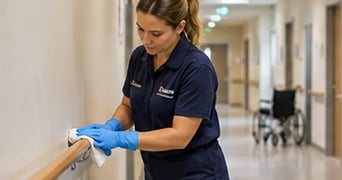
- Corridors and stairwells: vacuum or mop, spot-clean walls and doors, clean handrails, check fire stairs are clear of rubbish.
- High-touch points: intercom panels, lift buttons, door handles, push plates and handrails.
- Shared bathrooms and amenities: clean and sanitise toilets, basins and showers; restock consumables if included in the contract.
- Bin rooms and waste areas: sweep, wash down and deodorise; clean bins; tidy loose rubbish. Some contracts also include taking bins to the kerb on collection day.
- Car parks and driveways: litter pick-up and sweeping of pedestrian areas and entries.
For the difference between cleaning, sanitising and disinfecting high-touch surfaces, see the difference between cleaning and sanitising.
Periodic and specialist tasks
These are usually quoted and scheduled separately from the routine clean:
- Carpet steam cleaning of common-area carpets
- Hard-floor scrubbing, or strip and seal of vinyl
- Internal common-area glass and high-level dusting
- Full car park sweeps
- Shared pool, gym and BBQ-area deep cleans
- Gardening and grounds maintenance (mowing, weeding, pruning, leaf removal)
External high-rise windows, façades and gutters typically need specialist access equipment and contractors, so check how your scheme handles them.
What is usually not included
Unless your contract says otherwise, strata cleaning does not cover the inside of individual lots, removal of large dumped items such as furniture, biohazard clean-ups, or repairs. Ask how out-of-scope requests are priced and approved before you need them.
How often should a strata building be cleaned?
There is no legal minimum frequency for strata cleaning. The right schedule depends on the number of lots, foot traffic, whether there is retail or commercial use on the ground floor, and what amenities the building has. Use the table below as a starting point to adapt, not a standard.
| Area | Typical starting frequency | Increase if… |
|---|---|---|
| Main entry, lobby, lift interiors | 2–3 times a week | high-rise, retail frontage, wet weather tracking |
| Corridors and stairwells | Weekly or fortnightly | many lots per floor, carpeted corridors |
| Bin rooms | On or after collection days | odours, pest activity, overflow |
| Shared bathrooms, gym, pool amenities | Each service visit | heavy use, commercial tenants |
| Car park | Monthly to quarterly sweep | leaves, open car parks, oil spills |
| Common-area carpets | Once or twice a year | high traffic, spills |
| Grounds and gardens | Fortnightly to monthly, seasonal | large landscaped areas, spring growth |
Small walk-up blocks may need only one visit a week. Large mixed-use buildings may need daily cleaning of entrances and amenities. If the same complaints keep coming up – bin rooms, lift floors, entry glass – adjust the frequency for that area rather than for the whole building.
Who is responsible for strata cleaning in NSW?
In NSW, strata schemes are governed by the Strata Schemes Management Act 2015. NSW Fair Trading’s guidance summarises who does what.
The owners corporation
NSW Fair Trading states that “the owners corporation or strata committee must repair and maintain common property”, while lot owners maintain anything within their own lot. The owners corporation makes decisions and manages the overall scheme, and it can hire workers such as cleaners and gardeners itself or have the strata committee or strata manager hire them.
The strata committee
The owners corporation decides what the strata committee can decide on. NSW Fair Trading lists day-to-day spending, such as hiring repairers, as a typical committee power. Check your by-laws and AGM resolutions for any spending limits.
The strata manager
A strata managing agent only performs the jobs the owners corporation delegates to them, such as coordinating meetings, collecting levies and arranging insurance. In many schemes this includes getting quotes and engaging the cleaning contractor, but only if it has been delegated.
The building manager
Larger schemes may appoint a building manager to look after common property, including access, maintenance and repairs. Building managers must disclose any benefit, including referral fees or commissions, when suggesting a contract.
How strata cleaning is paid for
Cleaning is a day-to-day running cost. NSW Fair Trading describes the administrative fund as the “everyday fund” for the scheme’s day-to-day expenses and gives window or carpet cleaning and lawn mowing as examples. Major one-off work, such as repainting common property, comes from the capital works fund. Both funds come from strata levies set in the budget approved by owners.
Windows: a common grey area
NSW Fair Trading’s repairs guidance lists window cleaning as a lot owner’s responsibility unless you can’t reach the window, for example because it is too high. Your by-laws may say otherwise, so confirm what your scheme’s by-laws and strata plan say before you write windows into, or out of, a cleaning scope.
Work health and safety
SafeWork NSW explains that a body corporate responsible only for residential common areas is generally not a “person conducting a business or undertaking” for those areas. This changes where the building has mixed residential and commercial use, or where the body corporate employs workers. Whatever your scheme’s position, the cleaning contractor has its own duties to its workers. Ask for its safe work procedures, chemical safety data sheets and insurance certificates. If you are unsure of your scheme’s obligations, contact SafeWork NSW or get legal advice.
How to write a clear strata cleaning scope

A good scope protects the committee as much as the contractor. Include:
- A site list of every common area, including fire stairs, bin bays, plant room approaches and car park levels.
- Tasks and frequency per area, not one frequency for the whole building.
- Periodic tasks with the months they are due.
- Service times and access arrangements – keys, fobs, lift bookings and quiet hours.
- Who supplies consumables and chemicals, and any preference for low-toxicity products.
- How quality is checked – inspections, sign-off sheets or photo reports, and who receives them.
- How issues are reported and how quickly urgent spills or incidents are handled.
Our guide to strata cleaning costs, quotes and contracts explains how scope decisions affect price and what to look for in contract terms.
Frequently asked questions
How much does strata cleaning cost?
There is no standard price. The cost depends on how much common area there is, which areas are in scope, how often each is cleaned and what periodic work is added. Our guide to strata cleaning costs, quotes and contracts explains the cost drivers and how to compare quotes like-for-like.
What is strata cleaning and maintenance?
It combines routine common-area cleaning with upkeep such as grounds maintenance, waste handling and minor repairs, often managed by one contractor or facility manager. Cleaning and minor repairs are generally paid from the administrative fund. Major works are planned and paid for through the capital works fund. Outdoor areas like car parks, paths and concrete are also periodically pressure cleaned, and our guide explains the difference between power washing and pressure washing.
Does strata cleaning include gardening and grounds maintenance?
It can, but it is often scoped separately. Some schemes add mowing, weeding and leaf removal to the cleaning contract; others use a separate gardener. NSW Fair Trading lists lawn mowing alongside window and carpet cleaning as an administrative fund expense, so either way it is usually budgeted as a day-to-day cost.
What is body corporate cleaning?
“Body corporate” is the term used in some states, such as Queensland. In NSW the equivalent body is the owners corporation, but the cleaning service is the same.
Reviewing your scheme’s cleaning?
If your committee is rewriting its scope, or your current contractor keeps missing the same areas, start with a walk-through. B&K Services provides strata and common-area cleaning in Sydney, Wollongong and the Illawarra and Nowra and the Shoalhaven. We’ll walk the common property with you at no cost, then put the area-by-area scope and frequencies in writing so owners can see what the levies pay for. If grounds, waste, pest control or building maintenance are also on the committee’s list, they can sit under the same contract with one point of contact.
Book a free strata site walk-through or call 1300 136 954.
Summary
Strata cleaning is a specialised service that maintains shared spaces in properties like residential complexes and commercial buildings. It includes tasks such as cleaning lobbies, hallways, outdoor areas, and managing waste, ensuring the spaces are clean, hygienic, and safe for everyone. The service is tailored to the unique needs of each property type, promoting both aesthetic appeal and functionality.
When hiring a strata cleaner, it’s important to consider factors like experience, reliability, and customisation to meet specific property needs. Professional services like B&K Services ensure high-quality, consistent cleaning that enhances property value and tenant satisfaction, with flexible scheduling and transparent pricing.