1300 136 954
 info@bnkservices.com.au

Read Time: 9 Min
Strip and Seal: What It Is, When Floors Need It and How to Book It

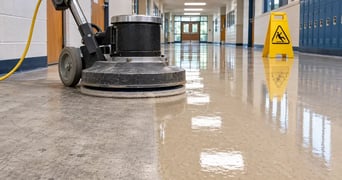
A strip and seal is a restoration job for vinyl and other resilient floors: a chemical stripper and a floor machine remove the old finish, the floor is rinsed and neutralised, then several fresh coats of sealer are applied and left to cure. Book one when the finish is worn through, yellowed or holding dirt that mopping and buffing no longer shift. If the floor is only dull, a scrub and recoat usually gets most of the result for less money and less downtime.
What happens during a strip and seal
- Preparation: furniture is moved out, edges are swept and the area is closed with signage.
- Stripping: stripper is applied and left to soften the old finish, then a rotary machine and stripping pad lift it. Edges and corners are done by hand.
- Rinsing and neutralising: the slurry is picked up and the floor rinsed, so no residue stops the new finish bonding.
- Sealing: thin coats of sealer go on once the floor is dry, with drying time between coats. Busy areas usually get extra coats.
- Curing: the floor is left to cure before foot traffic and furniture return, following the product's instructions.
Which floors can be stripped and sealed?
Strip and seal suits resilient floors with a removable finish: sheet vinyl, vinyl tiles, vinyl composition tile and linoleum. These are common in school classrooms and corridors, clinic treatment rooms, childcare play areas and back-of-house retail areas.
Some floors need a different process. Many modern vinyls have a factory finish the manufacturer says shouldn't be stripped, and timber, polished concrete and stone each have their own methods. Check the floor manufacturer's maintenance guide, or ask your contractor to confirm the floor type before quoting.
Signs your floor needs a strip and seal
- Dark, patchy traffic lanes where the finish has worn through to bare vinyl.
- Yellowing or a cloudy look from layers of old finish.
- Dirt trapped under the finish along walls and in corners.
- Black marks that no longer come out with buffing.
- A floor that looks dirty straight after it's mopped.
Strip and seal, scrub and recoat, or buff?
| Floor condition | Usual treatment | What it involves |
|---|---|---|
| Finish sound but dull | Buff or burnish | A high-speed machine restores gloss. Little or no downtime. |
| Scratched and dirty on top, not worn through | Scrub and recoat | The top layer is scrubbed off and one or two fresh coats added. Faster and cheaper than a full strip. |
| Worn through, yellowed or dirt trapped in old layers | Strip and seal | All old finish removed and the floor resealed from bare vinyl. |
A good maintenance plan uses all three: regular buffing, a scrub and recoat when the top layer is tired, and a full strip only when needed. Fewer full strips saves money and wear on the floor.
How often should commercial floors be stripped and sealed?
There's no fixed interval. It depends on foot traffic, grit from outside and day-to-day care. A busy school corridor or clinic entry may need it every year; a lightly used storeroom can go several years. Entry matting, regular dust mopping and a correctly diluted neutral cleaner all extend the time between strips.
How long does a strip and seal take?
Time on site depends on the area, how many layers of old finish there are, how much furniture has to move and how many coats go back on. Each coat has to dry before the next is applied, so most of the job is waiting rather than machine work. A single classroom or treatment room is often done in one shift. A long corridor or a whole wing may be split over several nights so parts of the building stay usable.
Light foot traffic can usually return once the final coat is dry, but the finish keeps hardening for some time after that. Ask your contractor what the product they use needs before heavy furniture, trolleys or equipment go back, and write that time into the plan.
Should you buy a machine or hire a contractor?
Most search results for strip and seal are how-to guides written by equipment and chemical suppliers. They are useful if you have trained staff and the right gear, but they leave out what a facilities manager has to weigh up:
- Equipment: a rotary or orbital machine, stripping pads, wet vacuum, signage and enough sealer for every coat.
- Labour and skill: stripping unevenly or sealing over residue leaves streaks and poor bonding that only another strip fixes.
- Chemical handling: strippers need PPE, ventilation and safe disposal of the slurry, guided by the product's safety data sheet.
- Downtime: in-house staff usually have to do it after hours on top of normal duties.
For one-off restoration across large or busy areas, a contractor is usually simpler. In-house machines make more sense for regular buffing and scrubbing between contractor strips.
Common mistakes that shorten the life of the finish
- Sealing over residue: if stripper or slurry isn't fully rinsed and neutralised, the new finish won't bond and can peel or turn cloudy.
- Thick coats: one heavy coat dries slowly and stays soft. Several thin coats last longer.
- Returning furniture too early: chair legs and desk feet press into a soft finish and leave marks that only another strip removes.
- Using the wrong stripper: linoleum and rubber floors can be damaged by strong alkaline strippers. Check the floor maker's guide for the right product.
- Skipping the edges: if corners and skirting lines are left with old finish, dirt keeps building there and the floor looks patchy.
- Harsh daily cleaners: strong or over-concentrated products dull the finish quickly and leave a film that attracts dirt.
Looking after the floor between strips
Day-to-day care decides how long the finish lasts. A simple routine stretches the time between full strips:
- Entry matting long enough to catch grit before it reaches the vinyl.
- Dust mopping daily, before damp mopping, so grit doesn't scratch the surface.
- A neutral cleaner at the right dilution, not a degreaser or bleach.
- Felt pads or glides on chair and desk legs.
- Regular buffing to bring back gloss, and a scrub and recoat when traffic lanes start to dull.
Slip resistance and safety
A glossy floor is not necessarily slippery, but the finish, the cleaning products and water on the surface all affect grip. In entries, wet areas and ramps, ask for a finish suited to that area and check it against your site's slip-risk assessment. During the work itself, the area must be closed off and signed while the floor is wet. Strippers also need gloves, eye protection and good ventilation, as set out in the product's safety data sheet.
Planning around downtime
A small area is often done overnight or over a weekend, but the floor also needs time to cure before heavy furniture goes back. Moving desks onto a soft finish can leave marks until the next strip. Agree these points before work starts:
- When the area closes, and when foot traffic can return.
- When furniture can go back, based on the product used.
- How wet floors, signage and ventilation are managed if other parts of the building stay open.
- Whether the finish suits entries and wet areas where slip resistance matters.
Schools usually book strip and seal over the summer break, clinics on a weekend after the last session, and offices on a Friday night so the finish cures by Monday.
What affects the price, and what to send for a quote
Strip and seal is usually quoted per square metre or per area after a site inspection. Price depends on the floor area and how it is broken up, the build-up of old finish, how much furniture must move and who moves it, the number of coats, after-hours or weekend timing, and edges such as fixed benches and stair nosings that need handwork.
To get comparable quotes, send each contractor the same brief:
- Approximate floor area of each room or zone, and the floor type.
- Photos of the worst traffic lanes and edges.
- The number of coats you expect in high-traffic areas.
- Who will move furniture and equipment, and where it can go.
- The dates and hours each area can be closed, and when it must reopen.
Our guide to commercial cleaning costs in Australia explains the labour and timing factors behind most cleaning prices.
Example: a clinic corridor (illustrative)
A medical centre with a vinyl corridor and five treatment rooms wants floors restored without cancelling appointments. The contractor finds the corridor finish worn through, while the rooms only need a scrub and recoat. The corridor is stripped and sealed on a Saturday after the last session, the rooms recoated the same night, and the practice confirms when equipment can roll back in. Monthly buffing after that delays the next full strip.
Frequently asked questions
What is the difference between stripping and sealing floors and polishing?
Polishing or buffing restores shine to a finish that is still sound. Stripping and sealing removes the old finish completely and puts new coats on bare vinyl. Polishing is routine maintenance; a strip and seal is restoration.
Can linoleum be stripped and sealed?
Often yes, but linoleum is sensitive to strong alkaline strippers, so the stripper and method must suit it. Check the manufacturer's maintenance guide first.
Can we stay open while the floor is done?
Usually only if the work is split into zones and each zone is closed while it is wet and drying. Most sites book after hours, on weekends or during holidays.
Is strip and seal the same as floor sealing for timber or concrete?
No. Timber, polished concrete and stone use different products and methods. Strip and seal in this guide refers to resilient floors such as vinyl and linoleum.
Need floors restored at your site?
B&K Services includes machine scrubbing, strip and seal and carpet care as periodic work in school cleaning programs, and quotes floor work for other commercial sites across Sydney, Wollongong and Nowra. Send us the floor area, floor type, photos and the dates the area can be closed. See school cleaning in Sydney, medical centre cleaning and childcare centre cleaning, or request a quote.
Summary
Pest control is crucial for businesses to prevent health risks, property damage, and reputation loss. Australia has many pests like termites, ants, and cockroaches, making regular pest management essential. Commercial properties should have pest control every three months, while food businesses may need monthly treatments. The frequency depends on factors like business type, location, and past infestations. DIY pest control is cheaper but less effective, time-consuming, and risky, whereas professional services ensure safe and long-lasting results. With over 30 years of experience, B&K Services provides expert pest control solutions to keep your property pest-free. Contact them today!