1300 136 954
 info@bnkservices.com.au

Read Time: 9 Min

Commercial cleaning is the professional cleaning of business and shared premises, such as offices, shops, medical centres, schools, warehouses, gyms and strata common areas, usually carried out by an outside company under a written contract. It covers the routine cleaning that keeps a site usable every day, the periodic work that protects floors and fittings, and the supplies that keep washrooms and kitchens running.
The real question for most businesses isn’t what commercial cleaning is. It’s whether to pay someone else to do it. This article explains what’s included, how outsourcing compares with an in-house cleaner, and when each makes sense.
What does commercial cleaning include?
Most commercial cleaning contracts combine three layers of work.
| Layer | Typical tasks | How often |
|---|---|---|
| Routine cleaning | Emptying bins, vacuuming and mopping, cleaning and restocking toilets, kitchen and break-room cleaning, wiping desks and high-touch points (door handles, light switches, lift buttons, taps) | Daily to several times a week |
| Periodic cleaning | Carpet extraction, hard-floor scrubbing and sealing, internal glass, high dusting, upholstery, deep cleans of amenities | Weekly, monthly or quarterly |
| Supplies and support | Toilet paper, hand towels, soap, bin liners, sanitary disposal, waste and recycling coordination | Ongoing, as agreed |
What’s included in your contract depends on the scope you agree. Nothing is “standard” until it’s written down, so check whether consumables, windows and periodic work are inside the price or quoted separately.
Commercial cleaning vs residential cleaning
The tasks look similar, but commercial cleaning differs in four ways:
- Scale and traffic: more people, more amenities, more wear.
- Timing: much of the work happens before or after business hours, often with the cleaner working alone.
- Safety obligations: cleaners are workers on someone else’s premises, so work health and safety (WHS) duties apply to both businesses.
- Contract and evidence: scope, frequency, inspections and records matter, because someone else is accountable for the result.
What do commercial cleaners do in different sites?

The basics are the same everywhere, but the risks change the scope. A medical centre needs a documented cleaning schedule for clinical areas. A school or childcare service needs cleaning around session times and appropriate checks for staff. A warehouse needs cleaners who understand forklift traffic and machinery areas. A strata building needs common-area cleaning the committee can see and verify.
In-house cleaner vs outsourced commercial cleaning
Neither option is right for every business. This is how they usually compare.
| In-house cleaner (your employee) | Outsourced commercial cleaning | |
|---|---|---|
| Employment | You recruit, pay wages and superannuation, manage leave and hold workers compensation cover | The contractor employs (or engages) the cleaners and carries those costs in its price |
| Cover for absences | You find and brief a replacement, or the work doesn’t get done | The contractor should supply relief cover; check how |
| Supervision and quality | A manager in your business checks the work | The contractor supervises and inspects; you check reports and results |
| Equipment and chemicals | You buy, maintain and store equipment, and keep safety data sheets for chemicals | Usually supplied by the contractor, with its own safety data sheets and training |
| Specialist work | Often needs a separate supplier (carpets, floors, windows) | Can be bundled into one scope, or quoted alongside |
| Flexibility | Fixed hours, hard to scale up or down | Hours and frequency can be changed by agreement |
| Control | Direct day-to-day control, and the cleaner knows the site well | Control through the scope, contract and account manager |
In-house can suit a single small site with steady, predictable needs, a manager with time to supervise, and someone already on staff who knows the building.
Outsourcing usually suits sites with after-hours cleaning, several locations, specialist floor or hygiene needs, regulated settings such as healthcare or childcare, or managers who would rather not supervise cleaning themselves.
The business case for outsourcing commercial cleaning
1. You still have a legal duty to keep the workplace clean
In NSW, the Code of Practice: Managing the work environment and facilities says the work environment must be maintained so that it remains in a clean and safe condition, and that facilities such as toilets, hand-washing and eating areas must be in good working order, clean, safe and accessible.
Outsourcing doesn’t hand that duty to the cleaning company. Safe Work Australia is clear that WHS duties can’t be transferred. What a good contractor gives you is a written scope, a schedule and records that show the duty is being met.
2. Costs are clearer and easier to compare
A contract wraps labour, supervision, relief cover, equipment and (if agreed) consumables into one predictable charge. With an in-house cleaner, those costs are spread across payroll, purchasing and management time, which makes the true cost harder to see.
This is also where “how commercial cleaning saves your business money” usually comes from. An outsourced service isn’t always cheaper per hour. The savings tend to come from:
- not paying for cleaning when it isn’t needed, because hours match the scope
- not losing a day’s cleaning when someone is sick
- buying periodic work such as carpet and floor care before damage needs replacing
- less management time spent supervising and fixing problems.
Be wary of any quote, from anyone, that promises savings without showing the labour hours behind the price. Most contract cleaners are covered by the Cleaning Services Award 2020, which sets minimum wages, penalty rates and overtime, so a price far below the market usually means fewer hours or lower wages rather than greater efficiency. For what drives the price, see what office cleaning costs and why.
3. Consistency you can check
A professional contractor works to a written scope and inspects against it. That gives you something you rarely get from an informal arrangement: evidence. Inspection reports, attendance records and a named contact mean problems are found and fixed before staff or clients notice.
4. Your floors, fittings and finishes last longer
Grit wears carpet and hard floors, and grime left on washroom fittings and benchtops is harder to remove later. Scheduled periodic cleaning protects what you’ve paid for. In a leased building, it can also help when it’s time to hand the premises back in the condition your lease requires.
5. Presentation for staff, clients and tenants

People notice a clean reception, kitchen and washroom, and they notice a dirty one more. For customer-facing businesses, strata buildings and practices, presentation is part of the service, and outsourcing makes it someone’s job to maintain it.
6. One contract can cover more than cleaning
Many businesses also need pest control, hygiene services, waste management or building and grounds maintenance. Bundling these with one provider, often called integrated facility management, means one scope, one point of contact and one invoice rather than a handful of separate suppliers. Read more about how B&K brings these services together.
When outsourcing might not be the right call
- Very small, simple sites where a few hours a week does the job and an existing staff member is happy to do it.
- Highly variable work that changes every day and can’t be written into a scope, unless the contract allows for it.
- When you won’t manage the contract. Outsourcing still needs someone to agree the scope, read the reports and raise problems.
Before you outsource: three practical steps
- List what you need cleaned, and how often, area by area. This becomes the starting point for every quote.
- Decide what you want evidence of: inspections, attendance logs, photos, or audit results.
- Compare at least two contractors on the same scope. Our guide on how to choose a commercial cleaning company sets out seven checks and a comparison table you can use anywhere in NSW.
If your main concern is staff health and day-to-day hygiene rather than who does the cleaning, see our guide to workplace hygiene and why a clean workspace matters.
Frequently asked questions
What is the role of a commercial cleaner?
A commercial cleaner carries out the routine and periodic tasks in the site’s scope of works, such as floors, washrooms, kitchens, bins and glass, while following the site’s safety rules. Under the Cleaning Services Award, more experienced cleaners may also run machinery such as scrubbers, train others or act as a leading hand, and senior staff supervise cleaners and deal with tenants or owners.
Is commercial cleaning the same as janitorial services?
Broadly, yes. “Janitorial” is more common in the United States; in Australia the usual terms are commercial cleaning or contract cleaning.
Can we use an in-house cleaner and a contractor together?
Yes. One common split is a staff member handling restocking and spills during the day, with a contractor doing the main after-hours clean and periodic work such as carpets and hard floors. Write down who does what, so tasks aren’t missed or paid for twice.
Do I still need a hygiene policy if I outsource cleaning?
Yes. Cleaners keep the premises clean, but they can’t control hand washing, food left in fridges or people coming to work unwell. Our workplace hygiene guide covers what a policy should include.
Weighing up outsourcing? Start with a scope
If you’re deciding between an in-house cleaner and a contractor, a written scope makes the comparison fair. B&K Services starts with a free site inspection and agrees the scope, frequency, timing and responsibilities in writing before any work begins, so you can set our price against what cleaning costs you now. Once the service is running, you get scheduled quality checks and one point of contact, and pest control, hygiene, waste or maintenance can be added under the same contract.
We work across Sydney, Wollongong and the Illawarra, and Nowra and the Shoalhaven. Explore our commercial cleaning services in Sydney, or request a free quote and call us on 1300 136 954.
Summary
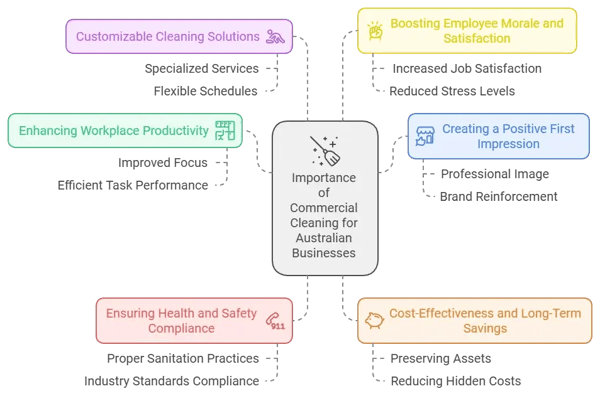
Maintaining a clean work environment is vital for Australian businesses as it boosts employee productivity, morale, and client impressions. A tidy workspace minimizes stress, enhances focus, and reduces illness-related absences by preventing the spread of germs.
Professional commercial cleaning services address these needs with tailored solutions, ensuring cleanliness in offices, retail spaces, healthcare facilities, and educational institutions. By outsourcing cleaning tasks, businesses benefit from improved productivity, compliance with health regulations, and long-term cost savings, creating a professional environment that drives growth and success.