1300 136 954
 info@bnkservices.com.au
Read Time: 16 Min
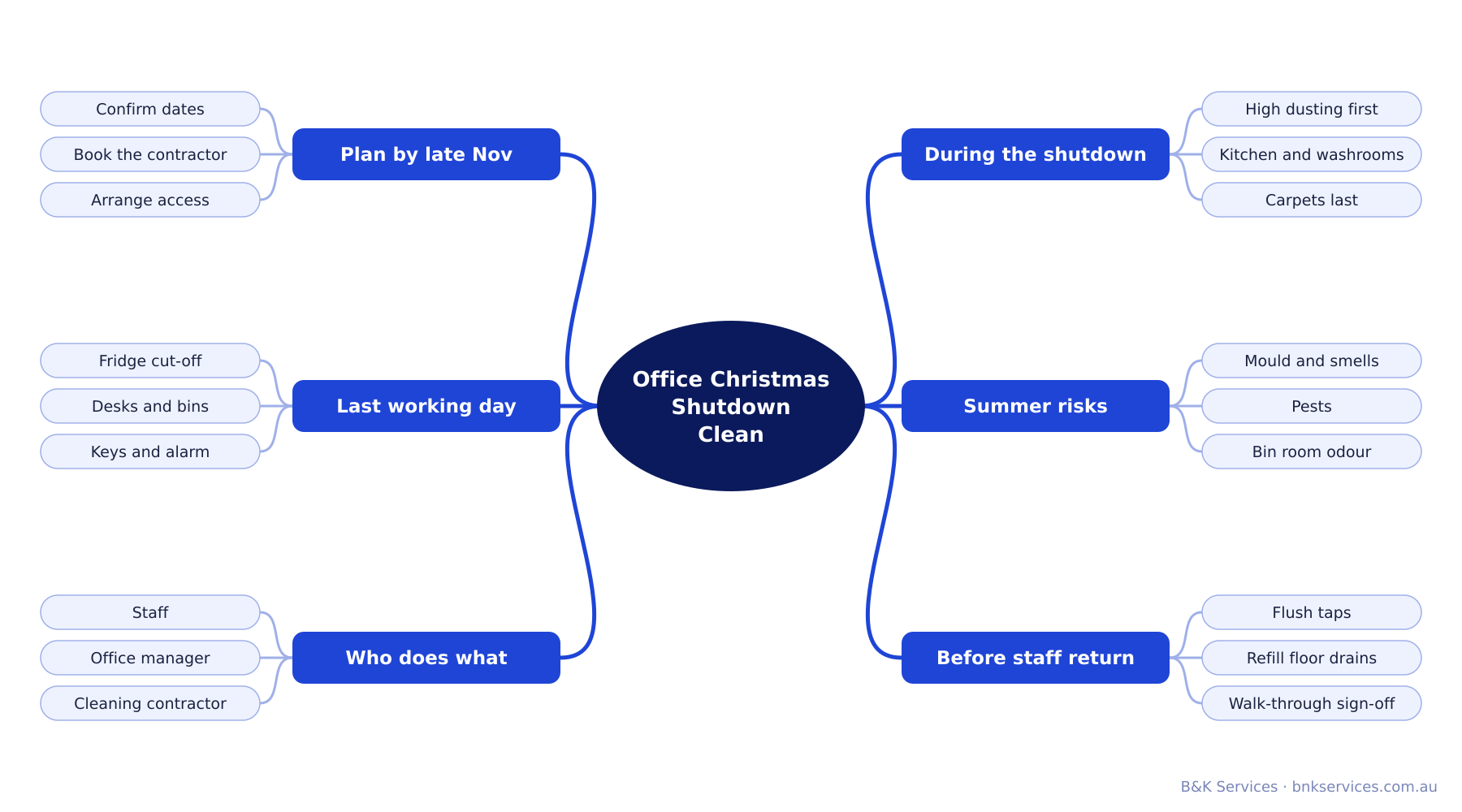
An office Christmas shutdown clean has three parts. Staff clear the fridge, desks and bins before the last working day. Contractors do the deep clean while the building is empty. Then a short return clean happens a day or two before everyone comes back in January. Plan all three by late November, because in NSW only three working days sit between Christmas and New Year.
This end-of-year office cleaning checklist is written for office managers, facilities managers and business owners in Sydney, Wollongong and Nowra. It shows who does each job, when to do it, and what to check before staff return. A printable handover sheet is at the end.
The office Christmas shutdown clean at a glance
The short answer: what to do and when
| When | What happens | Who owns it |
|---|---|---|
| 4–6 weeks out (mid to late November) | Confirm closure dates, agree the deep-clean scope, book the contractor, arrange access | Office or facilities manager |
| Last week before close | Send the fridge and desk clear-out notices, confirm the final bin collection, book shredding | Office manager |
| Last working day | Fridge emptied, desks cleared, bins out, appliances off, alarm and keys handed over | Staff and office manager |
| During the shutdown | Carpets, hard floors, washrooms, kitchen, high dusting and glass, done in the right order | Cleaning contractor |
| 1–2 days before staff return | Return clean, flush taps, refill floor drains, restock washrooms, walk-through sign-off | Contractor and office manager |
Why the shutdown is the best window for a deep clean
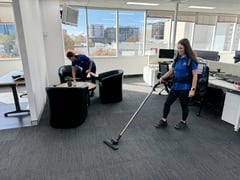
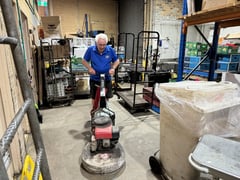
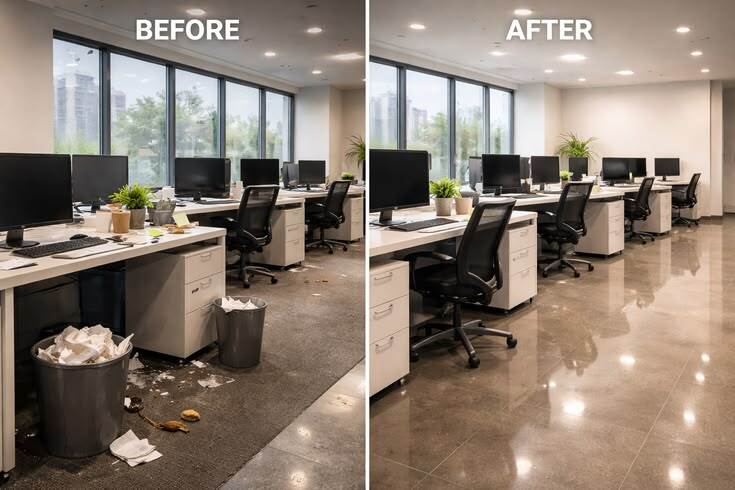
An empty office lets cleaners move furniture, steam clean carpets wall to wall and machine scrub hard floors. Carpets and floor coatings get time to dry or cure with no foot traffic. Nobody’s workday is interrupted by noise, wet floors or chemical smells.
A shutdown clean is a one-off deep clean. It sits on top of your regular service rather than replacing it. Your routine clean keeps the office tidy week to week. The shutdown clean reaches the grout, the carpet underlay, the high vents and the inside of the fridge.
When to book Christmas shutdown cleaning in NSW
Book your shutdown clean by late November. The 2026 NSW public holidays leave very few working days in the break:
| Date | Day | Status in NSW |
|---|---|---|
| 25 December 2026 | Friday | Christmas Day (public holiday) |
| 26 December 2026 | Saturday | Boxing Day (public holiday) |
| 28 December 2026 | Monday | Additional public holiday for Boxing Day |
| 29–31 December 2026 | Tuesday to Thursday | Working days |
| 1 January 2027 | Friday | New Year’s Day (public holiday) |
That leaves Tuesday 29, Wednesday 30 and Thursday 31 December as the main working days. These are the first dates to fill. If your office closes earlier, 21–24 December is another option. So is the first week of January, before staff come back.
Work on public holidays usually costs more, because penalty rates apply under the Cleaning Services Award. If your dates are flexible, booking a working day is the simplest way to keep the price down.
When you book, have these details ready:
- Your last working day and first day back
- Which areas are fully closed and which stay partly occupied
- The deep-clean tasks you want, such as carpets, hard floors, washrooms, kitchen and high dusting
- Who will let the cleaners in, and how (keys, swipe card or alarm code)
- Any restricted rooms, such as server rooms, records rooms or executive offices
Who does what: staff, office manager and cleaners
Most shutdown cleans go wrong because nobody owns the small jobs. Cleaners won’t throw out personal food, move a laptop or shred files. Staff can’t steam clean carpets. Split the work clearly before the last week.
| Task | Staff | Office manager | Cleaning contractor |
|---|---|---|---|
| Remove personal food from the fridge | ✓ | Sets the cut-off | |
| Clear desks, take home personal items | ✓ | Sends the reminder | |
| Lock away confidential papers | ✓ | Books shredding | |
| Take down decorations | ✓ | ||
| Confirm final bin collection | ✓ | ||
| Hand over keys, alarm code and access contact | ✓ | ||
| Deep clean fridge, microwave, dishwasher | ✓ | ||
| Steam clean carpets, scrub hard floors | ✓ | ||
| Detailed washroom clean and descale | ✓ | ||
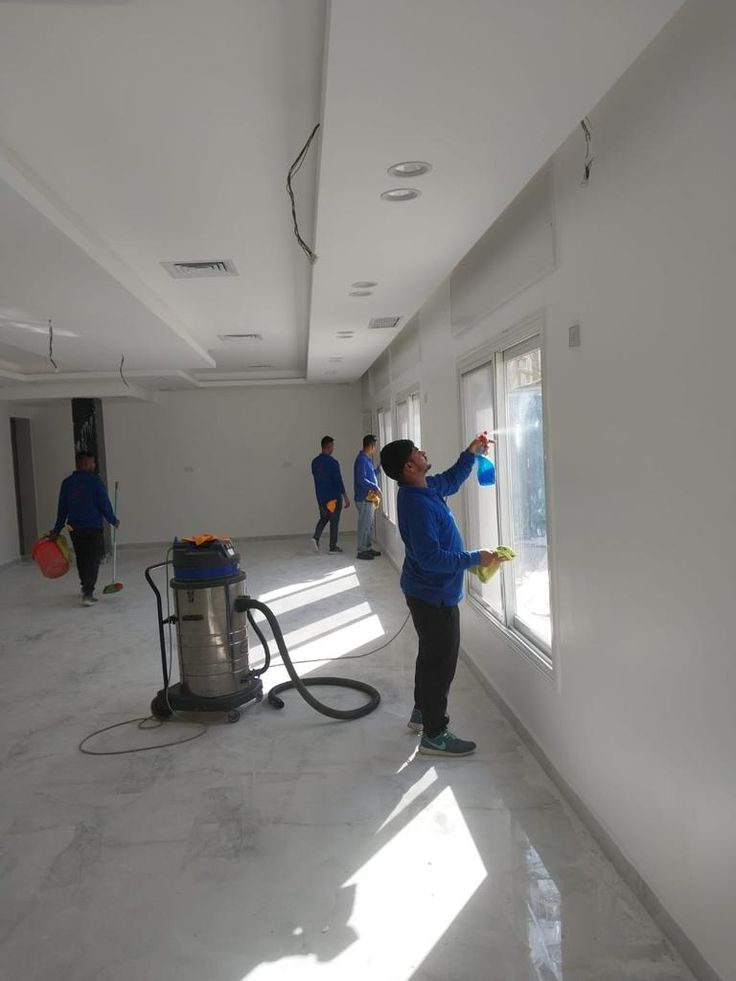
| High dusting, vents and internal glass | ✓ | ||
| Return clean before reopening | Signs off | ✓ |
Office Christmas shutdown cleaning checklist, room by room
Use this list to agree the scope with your contractor. Tick off each item as it’s done.
Staff kitchen and fridge
The staff kitchen is the biggest risk over a long summer break. Food left for two or three weeks in a warm office brings smells, mould and pests.
- Fridge cut-off set and announced (anything left after it goes in the bin)
- Fridge emptied, shelves and drawers removed and washed
- Door seals wiped and dried
- Fridge either left running at 5°C or below, or switched off, cleaned and propped open so mould can’t grow
- Microwave cleaned inside and out
- Dishwasher emptied, filter cleaned and door left ajar
- Coffee machine and kettle emptied, descaled and dried
- Benches, splashbacks, cupboard fronts and handles cleaned
- Cupboards checked for open food and crumbs
- Sink, tap and drain cleaned
- Kitchen bins emptied, washed and left dry
Washrooms and amenities
- Toilets, urinals and basins cleaned and disinfected
- Tiles and grout scrubbed, including behind toilets
- Taps, shower screens and fittings descaled
- Partitions, doors and handles wiped
- Mirrors and dispensers cleaned
- Sanitary bin service checked for the shutdown period
- Showers and end-of-trip facilities cleaned and left to dry
- Floors machine scrubbed, not just mopped
Desks, meeting rooms and shared areas
- Desks cleared by staff before cleaners arrive
- Desktops, monitors, keyboards and phones wiped
- Chairs vacuumed; upholstery cleaned if booked
- Meeting room tables, whiteboards and AV remotes cleaned
- Reception counter, glass and seating cleaned
- Light switches, door handles, lift buttons and other touch points disinfected
- Skirting boards, window sills and blinds dusted
Floors and carpets
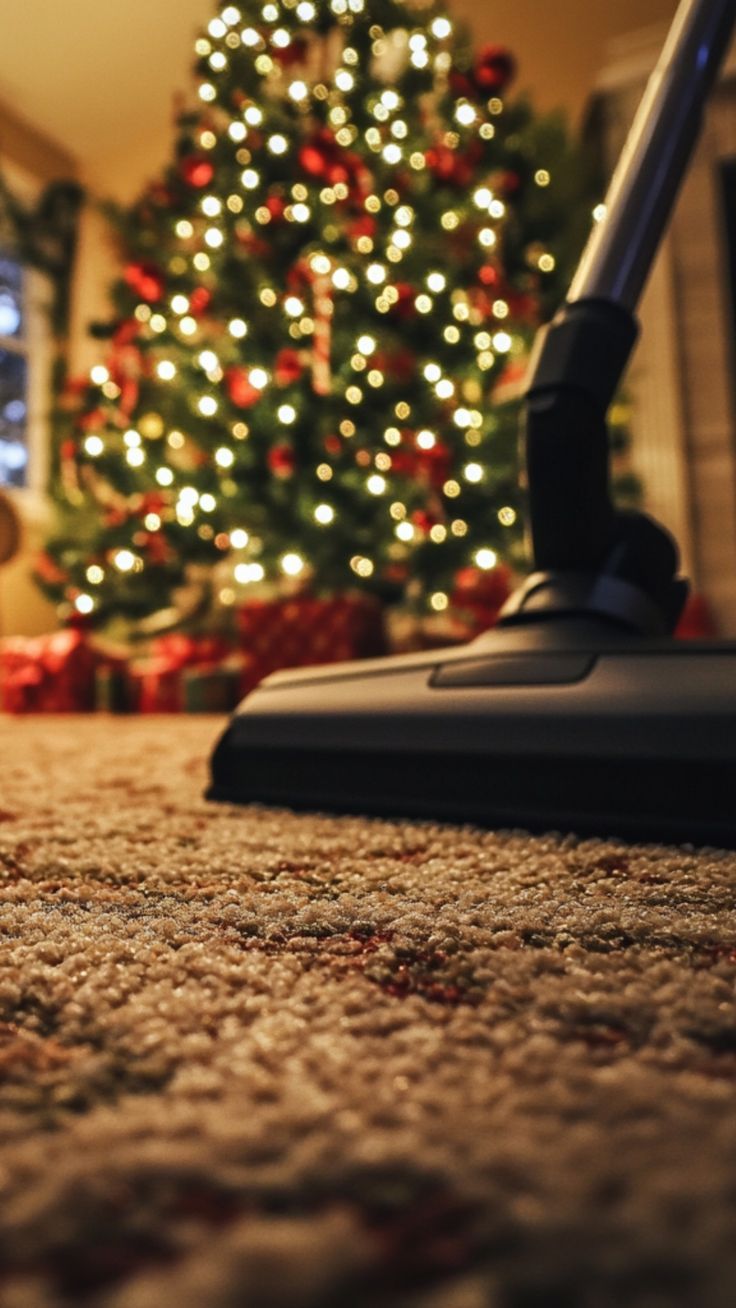
- Carpets vacuumed edge to edge, including under desks
- Carpets steam cleaned (hot water extraction) in high-traffic areas, or wall to wall
- Stains treated, especially near the kitchen and entrances
- Entrance and walk-off mats vacuumed and washed
- Hard floors machine scrubbed
- Vinyl floors cleaned with a neutral cleaner suited to the product
- Strip and seal booked where the floor needs it (see our guide to strip and seal floors)
Not every floor can be treated the same way. Safety vinyl is usually scrubbed, not polished. Some vinyl planks shouldn’t be steam mopped. Check the floor maker’s care guide, or ask your contractor to check it before the work starts.
High dusting, glass and fixtures
- Air-conditioning vents and return grilles dusted
- Light fittings and high ledges dusted
- Internal glass partitions and doors cleaned
- Inside of external windows cleaned where reachable
- Cobwebs removed from corners and ceilings
Waste, recycling and clean-out
- Final collection date confirmed with your waste provider or building manager
- All bins emptied before close, including under-desk bins
- Bins washed and left dry
- Commingled recycling and paper recycling put out separately
- Confidential papers placed in a locked shredding bin, not general recycling
- Old electronics, batteries and toner set aside for proper e-waste recycling, not the general bin
- Boxes and packaging flattened and removed
- Nothing left in the loading dock or bin room for two weeks
Collection days often move around Christmas Day and New Year’s Day. If your last pickup is before your last working day, food waste can sit in a bin room for two weeks or more in summer heat. Ask your provider for the holiday schedule and plan the final bin run around it.
What to do on the last working day
The last afternoon is when small jobs get missed. Give one person this list and the final walk-through.
- Fridge empty of personal food (or emptied by the office manager at the cut-off)
- Dishwasher run, emptied and left ajar
- Kettle, coffee machine and water urn emptied
- All bins emptied and taken to the collection point
- Desks clear enough for cleaners to wipe them
- Confidential papers locked away or in the shredding bin
- Computers, printers and non-essential appliances switched off at the wall
- Plants watered, moved or taken home
- Windows locked, blinds set
- Air-conditioning schedule changed for the break
- Keys, swipe card or alarm code handed to the cleaning contractor
- Out-of-hours contact name and number confirmed with the contractor and the building manager
Cleaning while you’re closed
The cleaning crew needs four things from you: access, a scope, a contact and a handback time.
Access and security
Decide who holds the keys, swipe cards or alarm codes for the break. Tell your alarm monitoring company that cleaners will be on site, with the dates and times. Give the contractor one name and phone number to call if they can’t get in or the alarm goes off. In a multi-tenant building, check with the building manager about after-hours entry, lifts and car-park access.
Work in the right order
The order of work matters as much as the scope. A good shutdown clean usually runs like this:
- High dusting first: vents, light fittings and ledges, so dust falls onto floors that haven’t been cleaned yet
- Kitchen, washrooms and fixtures next
- Desks, glass and touch points
- Hard floors scrubbed and sealed
- Carpets steam cleaned last, so nothing is walked over them while they dry
Ask your contractor for drying and curing times. Carpets often need several hours after hot water extraction, and longer in humid weather. A strip and seal needs time before foot traffic and furniture return. Plan the handback date around the slowest job.
Should regular cleaning continue during the shutdown?
It depends on whether anyone is in the building.
- Fully closed office: pause regular visits. Book one deep clean during the break and one return clean before staff come back.
- Partly open office: keep a reduced service for the occupied areas, usually washrooms, the kitchen and bins. Schedule the deep clean for the closed sections.
- Reception or skeleton staff only: keep light visits for the areas in use. Agree which floors or rooms stay locked.
Tell your cleaning contractor your shutdown dates in writing. A cleaning contract doesn’t pause by itself just because your business closes.
Summer risks in NSW offices over the break
An Australian Christmas shutdown falls in the hottest, most humid weeks of the year. On the Illawarra and Shoalhaven coasts, and in much of Sydney, that brings problems a northern-hemisphere checklist doesn’t cover.
| Risk | Why it happens | What to do |
|---|---|---|
| Fridge smells and mould | Food spoils fast in heat; a switched-off fridge with the door shut grows mould | Empty it fully; leave it on at 5°C or below, or turn it off and prop the door open |
| Pests | Crumbs and food waste attract cockroaches, ants and rodents | Clean cupboards and under appliances; empty every bin; consider a pest treatment during the break |
| Bin room odour | Waste can sit for two weeks if the last collection comes early | Time the final bin run to the holiday collection schedule |
| Mould in washrooms and grout | Warm, still, humid air with the air-con off | Clean and dry washrooms; leave doors open where it’s safe |
| Slow carpet drying | Humidity slows drying after steam cleaning | Book carpets early in the shutdown and allow extra drying time |
| Stale air on return | Air-con off for weeks | Air the office and run the air-con before staff return |
Before staff return in January
The return clean is a lighter visit, a day or two before reopening. It removes dust that has settled over the break and gets water and supplies ready for day one.
- Run every tap for a few minutes to flush water that has sat in the pipes
- Pour water into floor drains and shower drains to refill the traps and stop drain smells
- Flush every toilet
- Dust desks, sills and shared surfaces
- Wipe kitchen benches and touch points
- Restock toilet paper, hand towels, soap and sanitiser
- Check the fridge is clean, cold and empty
- Turn the air-conditioning back on early so the office is comfortable
- Look for signs of pests, leaks or mould
- Check carpets are dry and floors are ready for traffic
- Walk through with the contractor and sign off each area
- Confirm the date regular cleaning resumes
If your building has a large water system, cooling towers or a warm water system, ask your building manager about their reopening checks. These are usually the building owner’s responsibility, not the cleaner’s.
Copy-and-paste notices for staff
Send these in the last week before close. Change the dates and names to suit your office.
Fridge clean-out notice
Subject: Office fridge clean-out before the Christmas shutdown
Hi team, the office closes for Christmas at the end of next week. Please take home anything of yours in the fridge by 2pm on our last working day. Anything left after then will be thrown out so the fridge can be cleaned before the break. Thanks for helping keep the kitchen clean.
Desk clear-out reminder
Subject: Please clear your desk before the Christmas shutdown
Hi team, cleaners will be in over the break to deep clean the office. Before you leave on our last working day, please take home personal items and food, lock away confidential papers or put them in the shredding bin, and clear your desk surface so it can be cleaned. Thanks, and have a great break.
Cleaner access handover
Give your cleaning contractor one short handover note that covers:
- The site address and the floors or tenancies included
- Your last working day and first day back
- The agreed cleaning dates and times
- How the cleaners get in (keys, swipe card or alarm code) and who hands them over
- An out-of-hours contact name and mobile number
- The building manager’s name and number
- Any areas still occupied during the break
- Restricted areas, such as server rooms or records rooms
- The date and time every area must be ready for staff
How much does a Christmas shutdown clean cost?
A shutdown deep clean costs more than a regular visit because it covers more work and takes longer. The price depends on your site, so a fair quote starts with a site inspection. These are the main things that change the price:
- Floor area, and how many floors or tenancies are included
- Carpet area, and whether you want high-traffic areas or wall-to-wall extraction
- Hard floor work, such as machine scrubbing or a strip and seal
- Number of kitchens and washrooms
- Time since the last deep clean
- Specialist tasks, such as high dusting, internal glass or upholstery
- Access, including after-hours entry, lifts, parking and building rules
- The dates you choose, since public holidays attract penalty rates
To get an accurate quote, send your floor plan or square metres, the tasks you want and your shutdown dates. Ask for the scope in writing so you know exactly what is included.
Christmas shutdown cleaning in Sydney, Wollongong and Nowra
B&K Services cleans offices across Sydney, Wollongong and the Illawarra, and Nowra and the Shoalhaven. We can scope a shutdown deep clean, a return clean before staff come back, or both. Every job starts with a site inspection and a written scope, built around your closure dates, access arrangements and reopening day.
Planning an office shutdown? Ask B&K for a free site inspection and a written quote. Tell us your last working day, your first day back and what you want done, and we’ll plan the clean around it.
Frequently asked questions
When should I book Christmas shutdown cleaning?
Book in November, ideally by late November. In NSW the main working days in the break are 29, 30 and 31 December, and those dates book out first. Leaving it until mid-December limits your choice of dates.
What should be cleaned during the Christmas shutdown?
Focus on jobs that are hard to do while staff are in. That means steam cleaning carpets, machine scrubbing hard floors, a detailed washroom clean, a full kitchen and fridge clean, high dusting and internal glass.
Should I turn the office fridge off over Christmas?
You can do either. If you leave it on, empty it and keep it at 5°C or below. If you switch it off, empty it, clean it, dry it and prop the door open so mould can’t grow.
Who should empty the office fridge before Christmas?
Staff should remove their own food by a set cut-off. The office manager then clears anything left. The cleaner deep cleans the empty fridge. Announce the cut-off at least a few days ahead.
Can cleaners clean our office while we’re closed?
Yes. Most shutdown cleans happen when the building is empty. You’ll need to arrange keys, a swipe card or an alarm code, and give the cleaners an out-of-hours contact.
Do we need to be on site during the clean?
Usually not. Hand over access before you close, agree the scope in writing and do a walk-through when the work is finished or before staff return.
Should we keep our regular cleaning going during the shutdown?
If the office is fully closed, pause regular visits and book a deep clean plus a return clean. If some staff are still working, keep a reduced service for the areas in use.
How long does an office deep clean take?
It depends on the size of the office and the tasks. A small office may take a single day. Larger sites can take several days, plus drying time for carpets and curing time for floor coatings.
How long do carpets take to dry after steam cleaning?
Often several hours, and longer in humid weather or with poor airflow. Ask your contractor for an estimate and leave a buffer before staff return.
Why do office washrooms smell after a long break?
The water in floor drain traps can dry out when nobody uses the washrooms. That lets drain smells into the room. Pour water into the floor drains and run the taps when you reopen.
What’s the difference between end-of-year and new-year office cleaning?
The end-of-year clean is the big deep clean, done while the office is empty. The new-year clean is a lighter return clean a day or two before staff come back. It deals with settled dust, flushes taps, restocks the washrooms and gets the office ready for day one.
Printable office shutdown cleaning handover
Print this page or copy it into your own template. Fill it in before you close and keep it with your contractor’s scope.
| Item | Details | Owner | Done |
|---|---|---|---|
| Last working day | |||
| First day back | |||
| Fridge cut-off (date and time) | |||
| Final bin collection date | |||
| Shredding bin collection | |||
| Cleaning contractor and contact | |||
| Cleaning dates and times | |||
| Access method (keys, card, code) | |||
| Alarm company told | |||
| Out-of-hours contact | |||
| Areas still occupied | |||
| Restricted areas | |||
| Deep-clean tasks agreed | |||
| Carpets dry and floors ready | |||
| Taps flushed and drains refilled | |||
| Washrooms restocked | |||
| Walk-through sign-off | |||
| Regular cleaning restarts on |
Summary
Pest control is crucial for businesses to prevent health risks, property damage, and reputation loss. Australia has many pests like termites, ants, and cockroaches, making regular pest management essential. Commercial properties should have pest control every three months, while food businesses may need monthly treatments. The frequency depends on factors like business type, location, and past infestations. DIY pest control is cheaper but less effective, time-consuming, and risky, whereas professional services ensure safe and long-lasting results. With over 30 years of experience, B&K Services provides expert pest control solutions to keep your property pest-free. Contact them today!