1300 136 954
 info@bnkservices.com.au
Read Time: 10 Min
Colour-coded cleaning gives each type of area its own colour of cloths, mops, buckets and gloves. That way, equipment used on a toilet never ends up on a kitchen bench or a reception desk. In NSW Health facilities the colours are fixed and mandatory: red for toilets, bathrooms and dirty utility rooms, yellow for infectious and isolation areas, green for food areas, blue for general cleaning and white for operating theatres. Elsewhere in Australia colour coding is best practice rather than law, so the scheme your organisation has documented is the one that applies on your site.
This guide explains what each colour means and where the colours are mandatory. It also covers why charts disagree about yellow and what to ask your cleaning contractor.
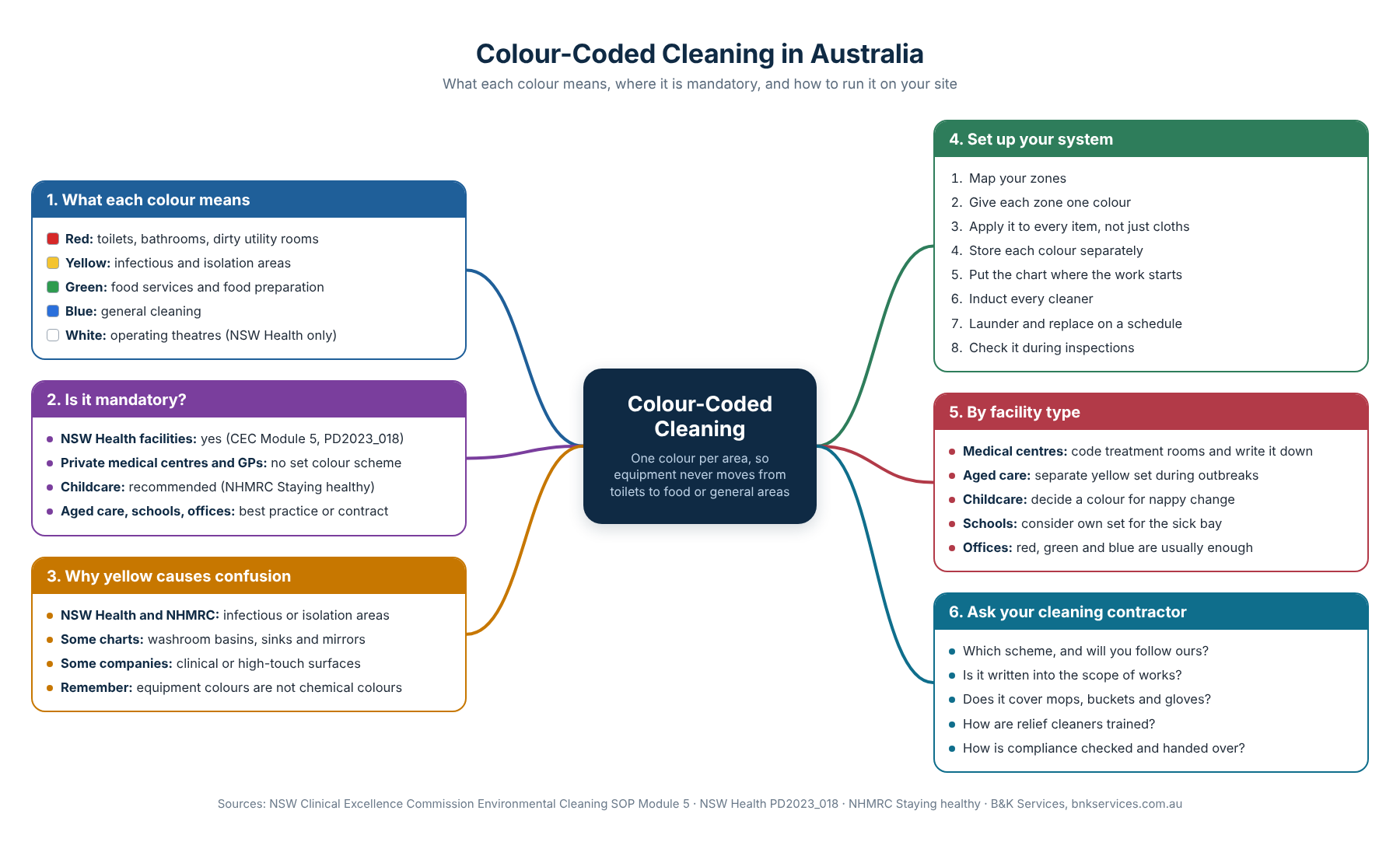
Colour-coded cleaning in Australia at a glance
What each colour means in Australia
The table shows the colours the NSW Clinical Excellence Commission (CEC) sets for reusable cleaning equipment in NSW Health. Beside them is the example from the NHMRC's guidance for early childhood education and care services, Staying healthy.
| Colour | NSW Health (CEC Module 5, October 2024) | NHMRC Staying healthy example (childcare) |
|---|---|---|
| Red | Toilets, bathrooms and dirty utility rooms | Bathroom |
| Yellow | Infectious and isolation areas | Infectious |
| Green | Food services and food preparation areas | Kitchen |
| Blue | General cleaning | General |
| White | Operating theatres | Not included |
Both sources use the same four everyday colours. White appears only in the NSW Health scheme, where it is reserved for operating theatres. Early Learning Victoria publishes the same four colours for its services in its colour codes for reusable cleaning equipment.
On any site, the scheme the organisation has written down governs. A chart from a supplier, a previous cleaner or another building does not override it.
Is colour-coded cleaning mandatory in Australia?
Only in some settings. Where things stand:
- NSW Health facilities: yes. The CEC's Environmental Cleaning SOP Module 5 states that its colour codes for reusable cleaning equipment are mandatory. The module sits under NSW Health policy directive PD2023_018, Cleaning of the healthcare environment. Compliance with that directive is mandatory for NSW Health organisations such as local health districts, public hospitals, community health centres and NSW Ambulance. The directive recommends colour coding as the most effective way to keep equipment to its own areas, and Module 5 makes the colours a requirement.
- Private medical centres and GP clinics: no set colour scheme. The NHMRC's Australian Guidelines for the Prevention and Control of Infection in Healthcare apply to all healthcare settings, including office-based practices such as general practice. The colour table itself is a NSW Health requirement. For a private practice, the CEC colours are a sensible default because many cleaners already know them.
- Childcare: recommended. Staying healthy asks services to consider colour-coding the cloths and sponges for each area so they are easier to keep separate.
- Aged care, schools, offices and other workplaces: best practice or contract. No national law makes colour coding compulsory in every Australian workplace. Where it is required, the requirement usually comes from the organisation's own infection prevention procedures, a cleaning contract or an audit.
In short: a NSW Health facility uses the CEC colours. Any other site chooses a scheme, writes it down and makes sure its cleaners follow it.
Why yellow causes the most confusion
Red, blue and green mean much the same on most Australian charts. Yellow does not.
- Under NSW Health and the NHMRC, yellow means infectious or isolation areas. Equipment used where an infection is known or suspected is kept apart from everything else.
- Some charts use yellow for washroom basins, sinks and mirrors, keeping red for toilets and urinals. This convention comes from UK schemes and still appears on some Australian supplier charts. It conflicts with the NSW Health meaning.
- Some cleaning companies use yellow for "clinical" or "high-touch" surfaces. That is a site-specific choice, not the CEC meaning.
The difference matters when a cleaner works across several sites. A cleaner trained on a chart where yellow means basins can carry that habit onto a site where yellow means isolation, or the other way round.
A site with no infectious or isolation areas may not need a yellow set at all. If so, the written scheme should say so, so that nobody improvises.
White is the other colour that varies. The CEC reserves it for operating theatres, while some charts use white for clinical areas in general. A medical centre without an operating theatre should decide how its treatment and procedure rooms are coded, and record the decision.
Equipment colours are not chemical colours
Some suppliers also colour their chemical bottles by product type. That is a separate system. A red bottle does not mean the product is for toilets. Keep the two apart: equipment colour tells you the area, and the label tells you the product.
How to set up a colour-coded cleaning system
Outside NSW Health you can choose your own scheme. What matters is that it is complete, written down and followed. A practical order:
- Map your zones first. List every type of area on site: toilets and amenities, kitchens and food areas, general areas, and any sick bay, isolation, clinical or nappy change areas.
- Give each zone one colour. Starting from the CEC colours keeps you in line with NSW Health and with cleaners already trained on it. Decide how any zone the chart doesn't cover will be coded.
- Apply it to every item, not just cloths. Mop heads, flat-mop pads, buckets, gloves and scrubbing pads all need a colour. One shared bucket undoes the system. Label every spray bottle with its contents.
- Store each colour separately. The CEC requires cleaning equipment to be stored in a designated area with access to hand hygiene facilities. Separate hooks, shelves or tubs for each colour stop items mixing.
- Put the chart where the work starts. A wall chart in the cleaner's store shows the scheme at a glance, including to relief staff and to cleaners whose first language isn't English.
- Induct every cleaner. Include casuals and relief staff, not just the regular team.
- Launder and replace on a schedule. The CEC requires reusable equipment to be cleaned, laundered and stored according to the manufacturer's instructions. Replace items once their colour fades and they are hard to tell apart.
- Check it. Look at the store, the trolley and the laundry during routine inspections. Our cleaning audit checklist shows how to build those checks into regular audits.
Then write the finished scheme into your cleaning scope or contract, so it survives a change of staff or contractor.
Colour coding by facility type
Medical centres and GP clinics
Patient toilets, staff kitchens, waiting areas and clinical rooms each need their own equipment. Under the CEC colours, toilets take red, the kitchen green, and waiting and administration areas blue. Decide how consultation, treatment and procedure rooms are coded and write it down, because white is the CEC colour for operating theatres only. For room-by-room tasks, see our medical centre cleaning checklist or our medical centre cleaning service in Sydney.
Aged care
Resident rooms and ensuites, dining rooms, kitchens and shared lounges are separate zones. An outbreak adds rooms where residents are under isolation precautions, which is when a separate yellow set matters most. Each home's infection prevention and control procedures set its colours. See our aged care cleaning standards checklist and our aged care cleaning service in Sydney.
Childcare centres
The NHMRC example uses red for the bathroom, green for the kitchen, blue for general areas and yellow for infectious areas. It doesn't give nappy change areas a colour, so the centre should decide on one and write it down. Our childcare cleaning checklist includes a weekly check of colour coding. Our guide to childcare cleaning products covers what to clean with. For contract cleaning, see childcare cleaning in Sydney.
Schools
The core zones are toilets and amenities, canteens, classrooms and corridors, and the sick bay. A sick bay used by unwell students is a good candidate for its own set, and canteen equipment should never go into the amenities. See our school cleaning checklist and school cleaning in Sydney.
Offices
An office can usually manage with three colours: red for washrooms, green for the kitchen or tea room, and blue for desks, meeting rooms and reception. See office cleaning in Sydney.
What to ask a cleaning contractor about colour coding
Use these questions when you compare quotes or review your current cleaner:
- Which colour scheme do you use, and will you follow ours?
- Will the scheme be written into the scope of works?
- Does it cover mops, buckets and gloves as well as cloths?
- How are new and relief cleaners trained on our scheme?
- Where will equipment be stored on our site, and how will it be laundered?
- How do you check the scheme is followed, and will you share the results?
- If we change contractors, what gets handed over?
Our commercial cleaning contract checklist covers the rest of what belongs in a cleaning agreement.
Common ways colour coding breaks down
- One bucket or mop for every area, even though the cloths are colour coded.
- Cloths of every colour stored or carried together.
- No chart in the cleaner's store, so new starters guess.
- Faded cloths that can no longer be told apart.
- A contractor's scheme that differs from the site's, or differs between buildings on one contract.
- A cleaner moving between sites that use yellow differently.
Frequently asked questions
What are the NSW Health cleaning colour codes?
CEC Module 5 sets five: red for toilets, bathrooms and dirty utility rooms, yellow for infectious and isolation areas, green for food services and food preparation, blue for general cleaning, and white for operating theatres. They are mandatory for reusable cleaning equipment in NSW Health.
What colour mop is used for toilets?
Red, under both the NSW Health scheme and the NHMRC childcare example. Some charts split the washroom, with red for toilets and urinals and yellow for basins, so check your site's chart.
What is a yellow cleaning cloth used for?
Under the NSW Health scheme, yellow is for infectious and isolation areas only. Some charts use yellow for washroom basins and mirrors instead, so your site's documented scheme decides.
Can an organisation choose its own cleaning colours?
Yes, outside NSW Health. Choose a scheme, write it down, apply it to all equipment and train everyone on it. NSW Health facilities must use the CEC colours.
Does colour coding replace cleaning or disinfecting?
No. Colour coding stops equipment carrying contamination from one area to another. Surfaces still need the right cleaning and disinfecting method. See the difference between cleaning, sanitising and disinfecting.
Get colour coding written into your cleaning scope
B&K Services cleans medical centres, schools, childcare centres, aged care facilities and offices across Sydney, Wollongong and Nowra. Our programs are built on a written scope that lists rooms, surfaces, frequencies and tasks, and that scope is the right place for your colour scheme.
Request a free quote, or see our medical centre, school, childcare, aged care and office cleaning pages. In the Illawarra or Shoalhaven, start with our Wollongong or Nowra services.
Summary
Pest control is crucial for businesses to prevent health risks, property damage, and reputation loss. Australia has many pests like termites, ants, and cockroaches, making regular pest management essential. Commercial properties should have pest control every three months, while food businesses may need monthly treatments. The frequency depends on factors like business type, location, and past infestations. DIY pest control is cheaper but less effective, time-consuming, and risky, whereas professional services ensure safe and long-lasting results. With over 30 years of experience, B&K Services provides expert pest control solutions to keep your property pest-free. Contact them today!