1300 136 954
 info@bnkservices.com.au

Read Time: 11 Min

A showroom cleaning checklist sets out what gets cleaned in each zone and how often: daily, weekly and periodically. For a car dealership, that means floors, glass, the customer lounge, service reception and washrooms every trading day. Weekly detail work and periodic floor care come on top. A good checklist also states what is not in the cleaner's scope, which is usually the display vehicles themselves.
The checklist below is built for dealer principals, dealership operations and facilities managers, managers of furniture, kitchen, bathroom and lighting showrooms, and property managers of bulky-goods centres. Use it to set up a new scope, check your current cleaner or prepare for a busy trading weekend.
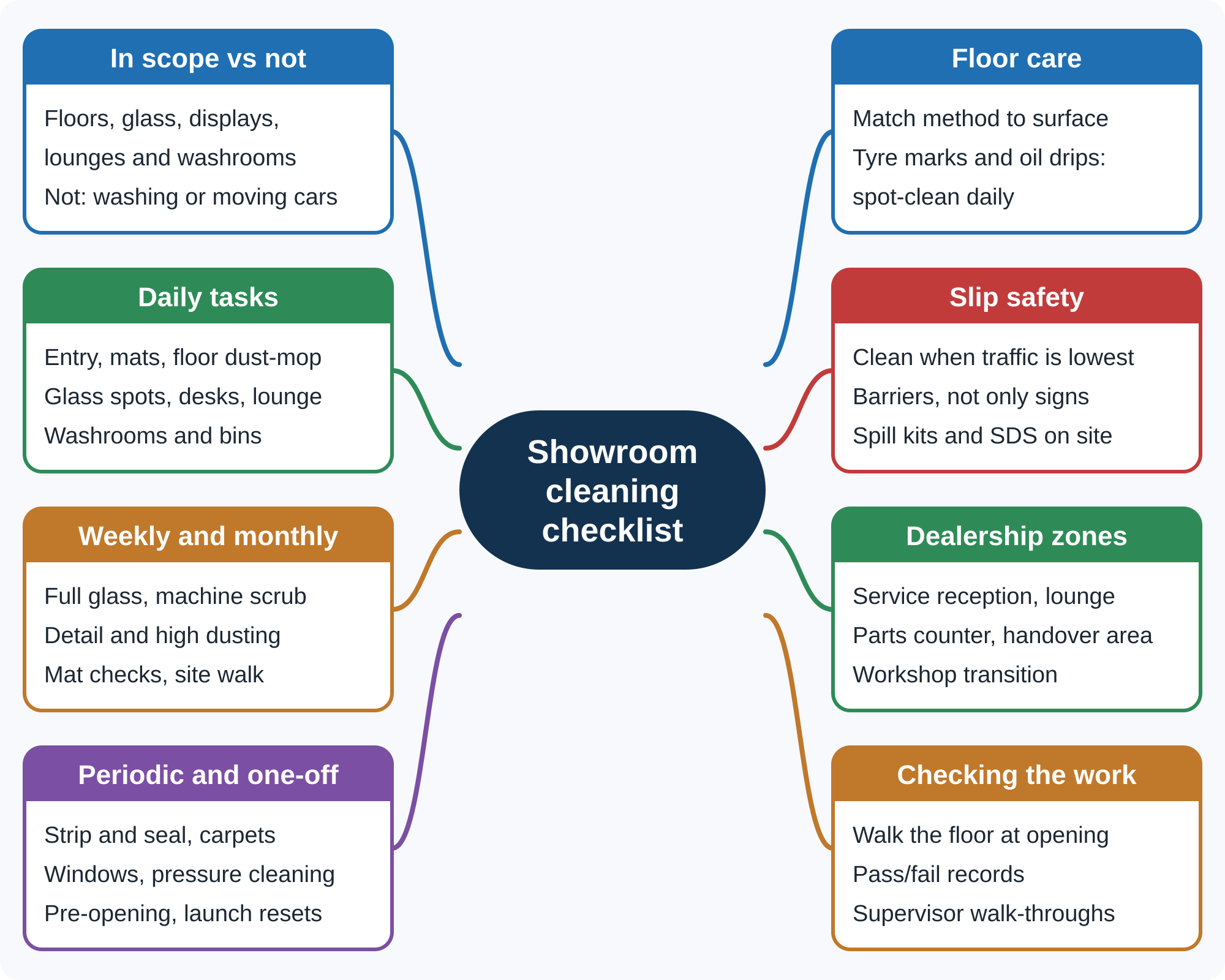
Showroom cleaning checklist at a glance
Why showrooms need their own cleaning checklist
A showroom is a large glass box with hard, often polished floors under bright directional lighting. That combination shows faults that would go unnoticed in an office: tyre marks, streaks on the frontage, dust on display stock, a dull patch where a mop left residue. In a showroom, the presentation is part of what you are selling.
Showrooms also have problems a retail store cleaning checklist doesn't cover:
- Vehicles and high-value stock are cleaned around, not moved or touched, unless the scope says otherwise.
- Workshops and loading areas track oil, grit and dust onto display floors.
- Large glass frontages show every smear in morning sun.
- Cleaning happens outside trading hours, often with nobody else on site.
- Peak days need resets. A floor that looked fine at Friday close can fail the Saturday-morning walk-through.
What is in scope and what isn't
Most disputes with showroom cleaners start because nobody wrote down where premises cleaning stops. Settle this before you compare quotes.
| Usually the premises cleaner | Usually not the premises cleaner (unless agreed in writing) |
|---|---|
| Floors, glass, entries and mats | Washing, detailing or polishing display vehicles |
| Dusting plinths, signage, brochure stands and display bases | Vehicle interiors, paint care, ceramic coating |
| Customer lounge, coffee station, sales and service desks | Moving vehicles or rearranging display stock |
| Washrooms, staff rooms and offices | Heavy workshop degreasing and hazardous waste (separate scope) |
| Spot cleaning of oil drips and tyre marks on the showroom floor | Cleaning fragile or delicate display pieces without instructions |
For furniture, kitchen, bathroom and lighting showrooms, the same rule applies to stock. Agree which display pieces the cleaner may dust or wipe, with what, and which must be left alone. If stock needs moving for floor work, say who moves it and when.
The showroom cleaning checklist by zone and frequency
The frequencies below are a common starting point, not a fixed standard. Foot traffic, floor type, weather and trading hours should set the final schedule. A busy Saturday dealership needs more than a quiet weekday lighting showroom.
Daily (every trading day, before opening or after close)
| Zone | Tasks |
|---|---|
| Entrance and threshold | Vacuum or shake out entry mats; sweep and mop the threshold; wipe door glass, handles and push plates. |
| Showroom or display floor | Dust-mop the whole floor, including around and under the edges of vehicles and displays. Spot-mop scuffs, tyre marks and drips. Leave no film or residue. |
| Glass | Spot-clean fingerprints and smears on the frontage, internal glass and glass display cases at ground level. |
| Displays (car showrooms) | Dust plinths, turntable edges, signage stands and brochure racks. Do not wipe the vehicles. |
| Displays (furniture, kitchen, bathroom, lighting) | Dust agreed display surfaces, benchtops, vanities and shelving edges, using the agreed method for each material. |
| Sales desks and service reception | Wipe counters, desks, key-drop area, EFTPOS surrounds, phones and chair arms. |
| Customer lounge and coffee station | Wipe tables and seating, clean the coffee machine surrounds and sink, empty bins, restock agreed consumables. |
| Customer and staff washrooms | Clean toilets, basins, mirrors and fixtures; refill soap, paper and towels; mop floors. |
| Offices and staff room | Empty bins, wipe benches and high-touch points, vacuum or mop. |
| Waste | Empty all bins and take waste and recycling to the agreed collection point. |
Weekly
- Clean full internal glass faces, not only spot marks.
- Machine-scrub high-traffic hard-floor areas where the floor type allows.
- Detail-dust skirting, ledges, window sills, display lighting bases and furniture legs.
- Clean the transition strip between workshop or loading areas and the display floor.
- Deep-clean the coffee station and lounge furniture.
- Wipe doors, frames, light switches and partition glass.
Monthly
- High dusting: vents, light fittings, track lighting, suspended signage and banners.
- Clean behind and under movable furniture in offices and lounges.
- Check entry mats for wear, curling edges or saturation, and report them.
- Walk the site with the cleaning supervisor and update the scope if needed.
Periodic (quarterly or as agreed)
- Hard-floor maintenance suited to the surface, such as scrub-and-recoat or stripping and sealing resilient floors.
- Carpet extraction in offices and lounges.
- External window cleaning and shopfront frames.
- Pressure cleaning of forecourts, entries and paths.
One-off cleans
- Pre-opening clean for a new or refitted site, including post-fit-out dust.
- Display changeover clean when stock or vehicle layouts change.
- Launch or event reset the night before, or early on the morning of, a big trading day.
Showroom floor cleaning: match the method to the surface
The floor is the largest visible surface in most showrooms, and the wrong method can do lasting damage. SafeWork NSW's guide to preventing slips, trips and falls says to use cleaning products and procedures suited to the type of flooring, and to refer to the manufacturer's advice for specific floors.
| Surface | What to watch for |
|---|---|
| Polished concrete | Haze or dull patches from the wrong product or residue. Follow the floor installer's or manufacturer's care instructions. |
| Sealed concrete and epoxy | Harsh chemicals can damage some coatings. Sealants can also make some floors more slippery, so check slip risk after cleaning. |
| Large-format tile or porcelain | Streaks and grout soiling show under showroom lighting. Rinse residue and dry properly. |
| Timber or laminate (furniture showrooms) | Too much water can damage the floor. Use damp, not wet, methods. |
| Vinyl and resilient floors | A worn finish dulls the look. Plan periodic recoating or strip and seal. |
Tyre marks and oil drips
Tyre marks build up where vehicles turn or are driven onto the floor, and oil can drip from stock and from vehicles coming in from the workshop. Spot-clean both daily. A heavy build-up of tyre-shine product or rubber may need machine scrubbing with a product suited to the floor rather than repeated mopping. Oil on the floor is a slip hazard as well as a presentation issue, so treat it as a spill, not as a cosmetic job for later.
Slip safety: the part of the checklist most guides skip
A gleaming floor can also be a slippery one. According to SafeWork NSW, slips, trips and falls are the most common cause of serious injuries at work in NSW after hazardous manual tasks. The same page names slippery floors from cleaning products and methods as a common risk, and lists a build-up of polish and excess detergent residue as things to check.
Build these into the scope:
- Clean wet areas when foot traffic is lowest, which in a showroom usually means after close or well before opening.
- Use barriers, not only signs. SafeWork NSW's guide says signs alone do not effectively keep people off a wet area, and recommends safety barriers until floors are fully dry.
- Agree a spill response for the showroom floor, with spill kits kept near where spills are likely, such as the workshop transition.
- Plan periodic deep cleaning to remove the build-up that daily mopping misses.
- Sequence floor work around vehicle and stock moves so nothing is driven or wheeled across a wet floor.
Chemicals and safety data sheets
Safe Work Australia states that anyone who uses or stores hazardous chemicals at a workplace must keep copies of the safety data sheets (SDS) there. If a contract cleaner brings products onto your site, ask how SDS will be kept on site and where the cleaner's chemicals will be stored.
After-hours and lone work
Much showroom cleaning happens when the site is closed. SafeWork NSW gives the example that a cleaner working at night in a city office is considered an isolated worker, and says businesses need a system of work that ensures effective communication with isolated workers. Agree with your contractor how lone cleaners check in, who they contact in an emergency and how alarms and lock-up are handled. Our guide to after-hours versus daytime cleaning covers the trade-offs of each schedule.
Car dealership cleaning checklist: zones beyond the showroom
A dealership is several sites under one roof, and each zone needs its own line in the scope:
- Service reception and key drop: the first thing a service customer sees. Counters, glass and floors daily.
- Customer lounge: customers may wait here for hours. Seating, tables, the coffee station and nearby washrooms daily.
- Handover or delivery area: clean and free of clutter before each scheduled handover.
- Parts counter: counter, customer-side floor and glass daily; back-of-house areas as agreed.
- Workshop transition: the doorway or strip between the workshop and showroom. This is where oil and grit migrate. Clean it daily and machine-scrub it weekly.
- Offices and staff amenities: standard office cleaning tasks.
- Forecourt and entries: litter pick daily; periodic pressure cleaning.
The workshop floor itself is usually a separate scope with its own safety controls. Keep it out of the showroom contract unless you have specifically scoped it.
Manufacturer and brand standards
Many dealerships work to presentation standards set by their manufacturer or franchise agreement. These are contractual between you and the brand, and they vary. If they apply to your site, give the relevant requirements to your cleaning contractor and write them into the scope, task by task. Then check the results against your own standards, not a cleaner's general promise.
How to check your showroom is being cleaned properly
Walk the floor at opening time, the hour that matters most. Look along the floor towards the light for tyre marks and residue, check the frontage glass in daylight, and look at the dust on plinths and display bases. A simple pass/fail record makes it easier to raise problems with your contractor. Our cleaning audit checklist gives you a template for scoring a cleaner's work against the agreed scope.
Ask for proof of attendance, such as a signed or photo checklist, plus a regular supervisor walk-through. If the same items keep failing, the scope or the schedule is usually the cause, not one bad night.
Frequently asked questions
How often should a showroom be cleaned?
Most showrooms need a clean every trading day for floors, glass, customer areas and washrooms, before opening or after close. Detail work such as full glass cleaning and machine scrubbing is usually weekly, with high dusting monthly and floor maintenance periodically. Busy dealerships may also need a pre-opening touch-up on peak days.
Does showroom cleaning include washing the cars?
Not normally. Premises cleaning covers the building: floors, glass, displays, customer areas and amenities. Washing and detailing vehicles is a separate service. Cleaners should dust around vehicles and plinths, and should not touch or move the cars unless the scope says so.
Will a cleaner move our stock or displays?
Only if it is agreed in the scope of works. Set out which items may be moved, who moves them and when, especially for fragile or high-value furniture, fittings and lighting.
Can a showroom be cleaned early on a Saturday before opening?
Yes, if it's agreed in the schedule. Many showrooms combine an after-close clean with a short pre-opening touch-up on their busiest days, covering the frontage glass, entry and floor spot marks.
Need a cleaner for your showroom?
B&K Services cleans commercial premises across Sydney, Wollongong, Nowra and the Shoalhaven. Our retail cleaning covers display areas, shopfront and internal ground-level glass, entrances and mats, customer bathrooms and staff rooms, before opening or after close. We also offer periodic machine floor cleaning, strip and seal, carpet cleaning, window cleaning and pressure cleaning.
We clean the premises, not the vehicles. Every site works to an agreed, written scope, so the zones, frequencies and boundaries in this checklist can go straight into yours.
- Showroom and retail cleaning in Sydney
- Showroom and retail cleaning in Wollongong
- Showroom and retail cleaning in Nowra and the Shoalhaven
- Commercial cleaning and periodic floor care in Sydney
Request a free quote or call 1300 136 954 to talk through your showroom's scope.
Summary
Pest control is crucial for businesses to prevent health risks, property damage, and reputation loss. Australia has many pests like termites, ants, and cockroaches, making regular pest management essential. Commercial properties should have pest control every three months, while food businesses may need monthly treatments. The frequency depends on factors like business type, location, and past infestations. DIY pest control is cheaper but less effective, time-consuming, and risky, whereas professional services ensure safe and long-lasting results. With over 30 years of experience, B&K Services provides expert pest control solutions to keep your property pest-free. Contact them today!